Enrollment falls at Michigan public colleges after years of steadiness
Published in News & Features
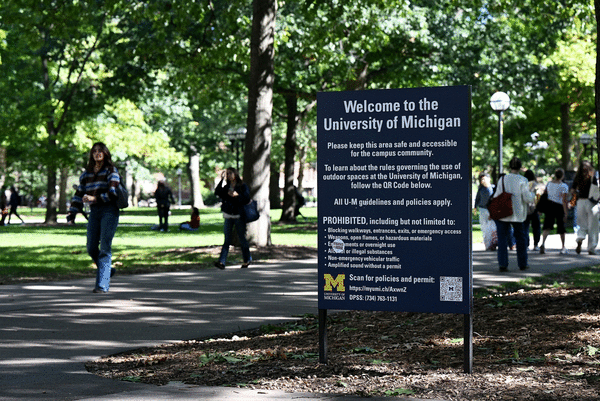
DETROIT — Michigan's public colleges and universities lost thousands of students over the past year, according to initial data from the Michigan Association of State Universities, disrupting an enrollment stabilization after the COVID pandemic.
More than 5,200 fewer students are enrolled in the 15 public colleges and universities across the state, a decline of 2%, the data shows. This comes after several years of incremental increases that gave state education leaders hope that the prior years of decline were stabilizing.
The decline in the number of traditional-age college students caused by falling birth rates and federal policies making it harder for international students to study in the United States contributed to the enrollment decrease, said Dan Hurley, CEO of the Michigan Association of State Universities.
Nearly all of the universities experienced a significant decline in students. Like last year, Lake Superior State University experienced the largest percent decrease in students, with totals dropping 14.4%, or 208 students. Eastern Michigan saw the second largest decrease, with totals dropping by 5.8%, or 708 students.
Just three universities saw increases: the University of Michigan-Ann Arbor, the University of Michigan-Flint and Wayne State University.
UM's flagship campus saw an increase of 1.3%, with 693 more students on campus this fall. The university's Flint campus saw an increase of 1.95%, or 139 students. WSU's increase of 0.1% was much more modest, amounting to an additional 14 students.
Is state spending working?
The state has put hundreds of millions of dollars into making higher education more affordable and accessible for Michigan students who plan to attend Michigan institutions. One example is the Michigan Achievement Scholarship — which allows eligible students from low-income to moderate-income families to get up to $5,500 per year for up to five years to attend a public or private college.
Without this spending, enrollment numbers would've dropped more than they did, Hurley said.
"If the state hadn’t more robustly partnered with these institutions, these figures would be much more austere with implications for the state’s social and financial ecosystem," he said.
However, Hurley acknowledged there was a "visibility issue" and the state needed to do more to make sure students and their families were aware of the aid available.
"(Higher education) is less expensive now than 15 years ago," he said. "The value and return on investment have only increased as it involves a four-year degree. The awareness of this is not fully realized among younger adults and parents and Michigan population at large. ... I think it’s a matter of messaging from the state and the overall culture."
Hurley said the enrollment decline was not a result of students feeling unprepared for college amid statewide declines in SAT scores, long considered one indicator of college readiness.
"I don’t think it’s a college readiness issue," he said, "although all aspects of the preparation ladder could benefit from some improvements. ... A year or two ago I would’ve attributed it to a strong economy where students wanted to join the workforce right away, but I don’t think that’s a factor here."
Types of students
Along with total enrollment, the numbers of first-time freshmen, undergraduate and graduate students all declined.
The number of graduate students took the most significant hit this year, the data shows. More than 2,918, or nearly 5%, fewer graduate students attended Michigan public universities.
Hurley said he believed this was due to the administration of President Donald Trump's actions to restrict the number of international students, who make up a significant proportion of graduate and doctoral students.
However, the number of new transfer students saw a modest increase of 0.9%, which Hurley said is due to state initiatives aimed at making postsecondary education more affordable. Michigan offers two years of free community college, and students who complete that can finish their bachelors degree at a four-year institution like the public colleges and universities, and Hurley said the data shows students are doing just that.
Although national numbers haven't been released yet, Hurley said Michigan likely had more students enrolled in higher education than other Midwestern states.
"Other Midwestern states would likely love to be where Michigan is at," he said. "I think we're in a good place to outcompete other states."
-------------
©2026 www.detroitnews.com. Visit at detroitnews.com. Distributed by Tribune Content Agency, LLC.





Comments