'Architect' of Feeding Our Future scheme sentenced to 30 years in prison
Published in News & Features
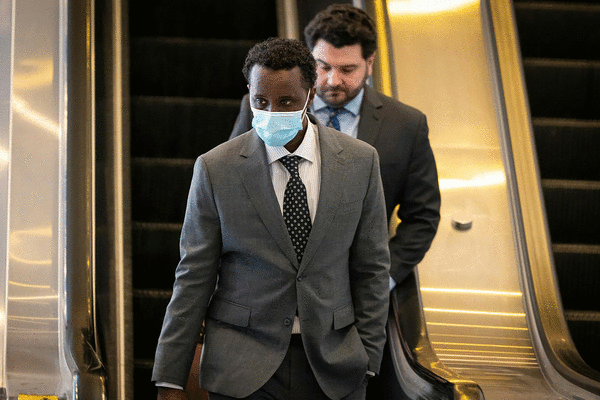
MINNEAPOLIS — Salim Ahmed Said, a central figure in the largest pandemic-era fraud scandal in the United States, was sentenced Wednesday to 30 years in prison for perpetuating the scheme to steal millions of dollars from a federal program meant to feed needy children.
Said, 37, was found guilty at trial last year alongside Aimee Bock, who is serving a nearly 42-year sentence as the ringleader of the fraud plot that came to be known as the Feeding Our Future case. The jury convicted Said of 21 crimes, including wire fraud and federal programs bribery, tied to his role in Feeding Our Future — Bock’s nonprofit at the heart of the scheme.
U.S. District Judge Nancy Brasel ordered Said to serve three years on supervised release following his time in prison.
Before receiving his sentence, Said apologized briefly to the judge in the downtown Minneapolis courtroom.
“Your honor, I am deeply sorry for the actions and my involvement in this very serious case,” he said. “You will never see me again in this or any courtroom on the wrong side of the law.”
Federal prosecutors sought a 40-year prison term, arguing that Said “deliberately weaponized a federal safety net designed to feed hungry children during one of the most vulnerable crises in modern history.” The defense sought 12 years, urging the court to consider Said’s difficult upbringing while also disputing the government’s portrayal of him as a main player in the scheme.
At his trial, Said described himself as a restaurant investor who unwittingly became caught up in a fraud scheme put on by others. He testified that the business he partly owned, Safari Restaurant in Minneapolis, served thousands of meals daily in 2020.
Prosecutors said the loss from the scheme connected to Safari Restaurant totals more than $44 million, a “significant chunk” of which Said pocketed to go on shopping sprees and purchase two luxury vehicles and a $1.1 million Plymouth home with an indoor basketball court.
Assistant U.S. Attorney Rebecca Kline rebuffed the claims that Said’s participation was a “lapse in judgement.”
“This was a systematic raiding of funds,” she said.
Said’s attorney Barry Zone contested the government’s portrayal of Said as the “undisputed” architect of the fraud plot, saying the label instead belongs to Bock, whom he called the “gatekeeper of all the money.”
Zone asked the court to consider Said’s upbringing in refugee camps where he experienced abuse after fleeing civil war in Somalia, calling the first 15 years of his life “hell.” He said his client’s past is “still not a defense to fraud,” but asked the court to “consider what’s happened to them.”
Brasel interjected to point out that Said was found responsible for the $44 million loss, an amount that very few of the other 81 people charged in the case are close to matching.
“I’m not saying the evidence shows he did anything good, it’s terrible,” Zone replied. “But he’s not the mastermind.”
Brasel said ultimately, whether Said was the architect or just a major participant of the fraud “doesn’t really matter.”
“You not only stole from the taxpayers, you did it by pretending you were helping,” Brasel said.
Brasel acknowledged the “absolutely tragic” nature of Said’s upbringing but said his crimes far outweigh his past, adding that she couldn’t see a nexus between his childhood and his fraud.
Brasel concluded that Said’s conduct eroded “the very foundation of our society.”
“You took more than taxpayer dollars to enrich yourself. You took the reputation of our state down with you,” she said. “It is my hope that one day, the words ‘Minnesota’ and ‘fraud’ will not be spoken in the same sentence.”
©2026 The Minnesota Star Tribune. Visit at startribune.com. Distributed by Tribune Content Agency, LLC.






Comments