New Spanish tragedy forces pre-election political reckoning
Published in News & Features
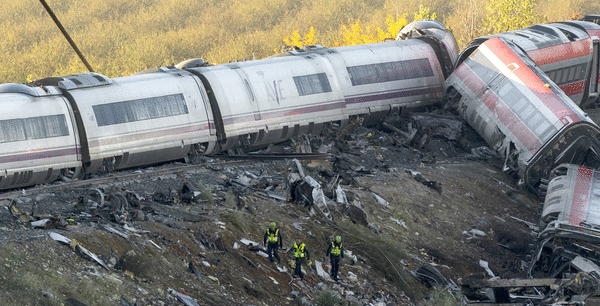
Antonio Hidalgo was on the sixth car of a commuter train bound for Seville on Wednesday morning, when about 118 kilometers (73 miles) south of Madrid, it collided with another train stopped on the track.
The high-speed collision and subsequent derailment resulted in at least 68 deaths – Spain’s deadliest rail crash in over a decade and second major collision this year. Deteriorating public infrastructure has plagued the country and addressing those issues risks getting caught up in political posturing ahead of a general election next month.
“I went flying down the hallway, and hit my eyebrow on the chair,” Hidalgo said in an interview, pointing to a bandage above his eye covering 12 stitches. “Because my eyebrow was split open, I couldn’t see; I wiped away the blood and looked for my partner.”
Destroyed seats, tray tables, suitcases and mobile phones littered his car, which was one of the first to stay on the rails.
The accident also represents a blow for Prime Minister Pedro Sánchez, who’s already facing a difficult election campaign. Polls show the conservative People’s Party leading with far-right Vox on the rise, and Wednesday’s events are likely to only increase scrutiny on Sánchez and his Socialist Party.
Sánchez headed a crisis committee meeting on Thursday near the site of the accident, and said no effort is being spared in the government’s response.
“All institutions in the administration — from the smallest municipality to the government of Spain — are working day and night,” he said. “Not only to provide answers to the families of the victims, but of course also to clarify every last detail of this tragedy and to strengthen safety so that this does not happen again.”
The Spanish leader tried to get out ahead of any attacks on Wednesday, vowing swift accountability from the crash site. All major political parties except Vox suspended scheduled campaign events and Sánchez declared three days of mourning.
But the detente won’t last. In a sign the accident will only further polarize Spain’s fraught political landscape, a union tied to Vox was already calling for demonstrations on Wednesday night in front of the Transportation Ministry in Madrid. And Vox leader Santiago Abascal was bashing Sánchez within hours of the crash, before the cause or death toll was known.
People’s Party leader Alberto Núñez Feijóo, the frontrunner to replace Sánchez, avoided explicit political attacks, merely calling for a government investigation and judicial inquiry “with full resources, and free from interference.”
“I am not going to get into a discussion about political responsibilities right now,” Feijóo told journalists in Madrid. “Today is not the day for that.”
Still, the PP’s official X account posted a message in bold black letters: “That’s enough.”
Meanwhile, drivers at state-owned train operator Renfe are striking on Thursday. The protest had been called prior to the crash over safety concerns and the union decided to maintain it after the accident. The strike affects both urban and long distance trains.
Wednesday’s collision appears to have come down to a fatal communication blunder.
At roughly 8:30 a.m., the railway’s automatic security system stopped working, according to Transportation Minister Óscar Puente. All trains in the affected area were halted and a control center in Madrid took over, operated by state-owned railway infrastructure operator Adif.
At around 8:36 a.m., however, someone at the Adif center ordered a train owned by state operator Renfe to resume its trip, despite the red signal showing a stalled train further down the line.
The Renfe train rolled 25 kilometers through an area where it could accelerate up to 200 kilometers per hour. After about 15 minutes, it slammed into the idle train, which was owned by Iryo, a company controlled by Italy’s state-owned Ferrovie dello Stato.
“There was an order to restart the journey, there was time to correct that decision,” Puente said.
Sánchez said Wednesday a government commission for railway accidents will investigate the causes, with early signs pointing to human error, unlike the crash earlier this year, which killed more than 40 people. He said what happened was unacceptable.
The number of catastrophes accumulating on Sanchez’s watch will inevitably come into sharp focus as his critics seek to pin the blame on him, asking voters to hold him accountable on Nov. 29 in a highly polarized environment of mutual recriminations. In 2024, more than 200 people died from the country’s most devastating flood disaster in decades. Sanchez’s delegation was pelted with rocks and mud by locals when he visited.
Sánchez also had to grapple with the fallout from a mass influx of migrants this summer, when about 80,000 people illegally crossed from Morocco into Ceuta, a Spanish exclave in North Africa.
In Wednesday’s tragedy, the railcars tumbled down a steep embankment, scattering pieces of debris and metal under the midday sun. Some of the carriages seemed to have been gutted from below, as if the train’s floor had been ripped off.
Overhead, two helicopters whirred alongside eagles as they flew over an old train station nearby. Thermal blankets dotted the landscape. Dozens of ambulances, cars and trucks whirred about.
“It was Dantesque,” said Eva María Masías, the owner of a local cheese shop who got to the crash just before 10 a.m. to support the rescue efforts. “It’s a situation that you never imagine yourself facing.”
When she arrived, emergency services were pulling passengers out of the trains. With her company’s trucks she brought water, blankets, chisels and compressors. Local residents were helping drive survivors to a sports center in the nearby town of Urba.
“What struck me most was the look of utter bewilderment on people’s faces,” she said. “It wasn’t fear — it was a look that ... well, there are no words to describe it.”
—With assistance from Thomas Gualtieri, Julia Janicki and Alberto Brambilla.
©2026 Bloomberg L.P. Visit bloomberg.com. Distributed by Tribune Content Agency, LLC.



Comments