Illinois House Speaker Chris Welch faces revolt as 26 Democrats call for new leadership after Benton scandal
Published in News & Features
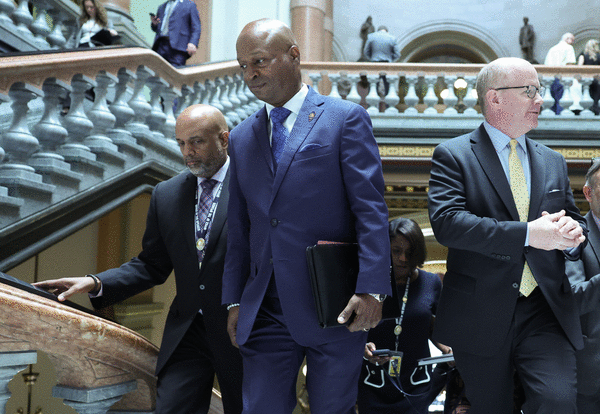
CHICAGO — Illinois House Speaker Emanuel “Chris” Welch’s hold on power has been thrown into doubt after 26 current and incoming Democratic lawmakers, nearly a third of his caucus, called for new leadership following months of criticism over his handling of sexual harassment allegations and his leadership style.
In a brief statement issued late Wednesday, a day after unofficial results showed Democrats expanded their supermajority in the 118-member chamber to a record of at least 83 seats, the current and incoming House members said that over the past few months they “have grown convinced that the House Democratic Caucus needs new leadership.”
“We represent a broad spectrum of our caucus, and each have come to this decision for our own reasons. We look forward to a robust race for a new Speaker of the House,” the statement said.
Welch was not immediately available for comment.
Welch needs at least 60 votes to keep the speakership when the new General Assembly is sworn in in January. If all 26 signers hold firm, he would fall short even if every other House Democrat backed him, based on the 83 Democrats winning their seats.
The release of the no-confidence statement injects a major element of political uncertainty into the fall veto session, which begins Nov. 17 in Springfield. Lawmakers are expected to take up economic incentives for a proposed Chicago Bears stadium and possible regulation of data centers.
A challenge to Welch had been expected to surface after Tuesday’s election, given his vast control over the campaign money that current and prospective members rely on.
The signers include four members of Welch’s leadership team. State Rep. Elizabeth “Lisa” Hernandez of Cicero, a deputy majority leader who chairs the Illinois Democratic Party and is an ally of Democratic Gov. JB Pritzker, who was just reelected to a third term, state Rep. Eva-Dina Delgado of Chicago, an assistant majority leader, and Assistant Majority Leaders and Floor Whips Katie Stuart of Edwardsville and Bob Morgan of Deerfield.
Two signers of the statement were elected to the House in Tuesday’s balloting: Paul Kendrick of Chicago, who is succeeding state Rep. Margaret Croke, who was elected state comptroller, and Maria Peterson of North Barrington, who defeated three-term Republican state Rep. Martin McLaughlin of Barrington Hills.
Also signing the statement was state Rep. Jessica Dixon Heitman of Plainfield, who won election on Tuesday. Heitman was appointed in July to fill the seat vacated by the resignation of disgraced former state Rep. Harry Benton.
Welch’s controversial handling of sexual harassment allegations against Benton, detailed in a Tribune investigation published in July, has fueled internal disputes among House Democrats over whether he should remain speaker. Progressive women have led the criticism.
The Tribune investigation found that Welch’s office knew for three years, since April 2023, that a young female staffer in Benton’s district office had accused the Plainfield Democrat of sexual harassment. The office did not raise the allegations with Benton until three months later. By then, she had quit his office, telling the Tribune she feared for her mental health.
Despite her allegations, political committees controlled by Welch contributed $1.4 million to Benton’s successful reelection campaign the following year.
Welch did not take disciplinary action against Benton until earlier this year, when two more women — a lobbyist and a district office staffer for another legislator — said Benton had sexually harassed them. In February, Welch stripped Benton of his committee assignments and other caucus duties.
Benton resigned July 3, several weeks before then-Legislative Inspector General Michael McCuskey found he had broken state law and engaged in a “pattern and practice” of sexual harassment.
The Tribune investigation also revealed that Welch himself had interacted with the former Benton staffer on social media, including responding to images of her with heart-eye emojis. He had also asked her over the encrypted messaging app Signal to meet in the bar area of a suburban restaurant. The woman once interned in Welch’s office.
According to the speaker’s spokesperson, the two had a “cordial friendship,” and the communications did not occur while she was interning. The former staffer told the Tribune the emoji responses made her feel “uncomfortable.” Welch later publicly apologized.
After the Tribune published its investigation, Welch moved quickly to contain the political fallout. He held meetings with various caucuses within the Democratic majority and told members the delay in acting against Benton stemmed from the wishes of the former Benton staffer who first reported the allegations. The former Benton staffer told the Tribune she did not recall telling the speaker’s office to delay taking action.
In the days after the report, some women House members who attended Welch’s virtual meetings said they were hesitant to support his leadership as speaker. One female lawmaker told the Tribune she felt that Welch was victim-blaming as he tried to explain his actions.
Welch had described his handling of the initial complaint as a “he said, she said” matter and said Benton was entitled to “due process.”
In July, as his leadership was embattled over his handling of Benton’s conduct, Welch told members of the House Democratic Women’s Caucus that his support for his reelection of Benton, a union ironworker, was due in part to fears that Benton’s criticism of the speaker could affect backing from organized labor, a powerful and well-funded Democratic ally, sources who attended the meeting told the Tribune. But some Democrats close to labor privately scoffed at Welch’s explanation, saying Benton had little power to influence organized labor or their fundraising apparatus.
Welch later pledged institutional reforms and formed a closed-door Democratic working group to examine House workplace culture and accountability. Three House Democrats quickly declined to serve on it, arguing the speaker was not setting up a collaborative or transparent process — state Reps. Kelly Cassidy of Chicago, Gregg Johnson of East Moline and Tracy Katz Muhl of Northbrook. All three signed Wednesday’s statement.
“Why (was) it appropriate to continue to support (Benton with campaign contributions)? Why was he not excommunicated from the caucus in that same election cycle as people that (Welch) financed primaries against,” Cassidy asked after the Tribune published its investigation. “Why did Welch just do the most cursory of — I can’t even call it an investigation.”
The House Democratic Women’s Caucus also criticized Welch’s handling of the matter as “insufficient,” saying it lacked support for the victim. The caucus chair, state Rep. Mary Beth Canty of Arlington Heights, said she was “troubled” by Welch’s conduct toward staff and that it fell short of the “highest standards of professionalism” expected of legislative leaders. Canty also signed Wednesday’s statement.
Questions over Welch’s handling of the Benton situation have created tensions within the House Democratic caucus between some women lawmakers unhappy with the speaker and some members of the House Black Caucus who are protective of Welch, the state’s first Black speaker of the House. House Democrats include 46 women and 22 Black Caucus members.
Welch was elected speaker, in part, after an uprising by women legislators unhappy with how former veteran House Speaker Michael Madigan handled sexual harassment issues involving his staff and campaign operation in 2017 and 2018. A subsequent corruption investigation, for which Madigan is currently in federal prison, led to Welch’s election as speaker in 2021.
Beyond the Benton case, some House Democrats have privately criticized how Welch runs the chamber, including a rule that a measure must have the 60 votes needed for passage before it can reach the House floor. Others have privately described the chamber’s operation as chaotic.
Some members have also objected to his decision this campaign season to separate House Democratic campaigns from the state Democratic Party’s coordinated campaign funding strategy.
Welch has grown increasingly concerned about keeping his post, according to sources. He has pointed to Tuesday’s results, in which Democrats flipped at least five Republican-held House seats, as justification for taking control of the caucus campaign.
“This is what a winning political operation looks like,” Welch said in a statement issued by his Democrats for the Illinois House campaign committee. “We didn’t just recruit candidates and protect the seats we had, we challenged ourselves to compete and expand. We followed the data, backed our candidates, and made the investments necessary to win.”
In addition to the Benton scandal, Welch’s campaign operation has also drawn scrutiny for backing Democratic state Rep. Amy “Murri” Briel of Ottawa, who was accused this summer of mistreating former staffers during her 2024 campaign.
One accuser spoke out against Briel in a roughly 40-minute video interview coordinated by the campaign of Republican Liz Bishop of LaSalle, Briel’s opponent this year. The woman in the video alleged Briel made advances toward her and fostered a hostile work environment. Two other former Briel campaign staffers also said she mistreated them during the 2024 campaign.
Before he resigned earlier this year, McCuskey reviewed a complaint from the accuser in the video but, by law, could not investigate because many of the events she described involved campaign activity that predated Briel’s swearing-in and fell outside his jurisdiction.
Briel denied the allegations after they became public but withdrew from a House Democratic working group Welch created to explore ways to improve workplace safeguards in the General Assembly, part of the speaker’s response to the Benton case. Meanwhile, Welch’s campaign operation has supported Briel with more than $310,000 in the past two weeks , state Board of Elections records show.
Briel defeated Bishop on Tuesday to win a second term.
Separately, in July, six-term Democratic state Rep. Carol Ammons of Urbana was indicted on federal charges alleging she orchestrated a scheme to enrich herself with taxpayer and campaign funds. Ammons has pleaded not guilty to charges of wire fraud, making a false statement to authorities and conspiring to obstruct justice.
A Democrat from west suburban Hillside, Welch has served in the House since 2013. When he was elevated to speaker in 2021 he faced his own questions about his past treatment of women.
In January 2002, an ex-girlfriend accused Welch of domestic violence, alleging in a police report that he slammed her head into a kitchen countertop numerous times after she called him a “loser.” Welch denied in the report “ever grabbing (the woman) by the hair and striking her head.” She declined to pursue charges after talking it over with a relative of Welch’s, the report states.
In 2009, a dean of students in the Proviso Township High Schools District 209 filed a federal lawsuit accusing Welch of engineering a sham policy to get her transferred in retaliation for not giving him a hug when he asked. She moved to dismiss the suit not long after filing it, saying she could not afford to continue.
In 2010, another woman filed a federal sexual harassment and retaliation lawsuit alleging she lost her job with the district because she broke up with Welch when he was school board president. She moved to dismiss the wrongful termination case shortly after settlement talks began.
____
©2026 Chicago Tribune. Visit at chicagotribune.com. Distributed by Tribune Content Agency, LLC.




Comments