Florida legislative leaders say not 'a dang thing' changes after blue wave election
Published in News & Features
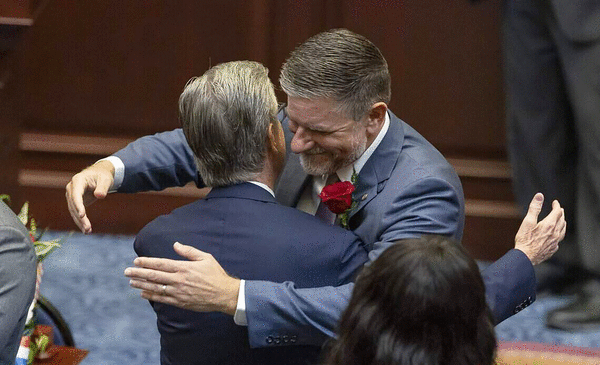
TALLAHASSEE, Fla. — Florida’s new legislative leaders are taking the midterm election results as an endorsement of Florida’s conservative agenda, despite the historically close margins and Democratic wave elsewhere in the country.
During swearing-in speeches Tuesday and in remarks to reporters, Florida’s new Senate President Jim Boyd, R-Bradenton, and House Speaker Sam Garrison, R-Fleming Island, acknowledged the national rejection of MAGA on Election Day — but made clear Florida will continue plowing ahead as the testing ground for conservative policies.
“Let’s be real, we got punched in the mouth the other day,” Garrison told the Republican caucus Monday. “For the first time in a long time, those of us who have only known pure success tasted a little blood.”
Some Republican incumbents in the Legislature won their seats narrowly. Gov.-elect Byron Donalds won by less than two points.
Those closer calls won’t affect the way Florida House Republicans operate in the upcoming legislative session, however, Garrison said. He dismissed questions about whether he would moderate to respond to the vote shift, saying he would change “not a dang thing.”
Boyd also highlighted that Florida Republicans fared better than their colleagues in other GOP strongholds around the country.
“Florida’s headed in a pretty good direction. I think the elections pretty much said that,” he said.
While Republicans still hold the majority in both chambers, it does mark a notable shift in power that Florida Democrats are no longer in the superminority. Headed into this Legislative session, Florida House Republicans are 16 members weaker. Florida Republican Senators lost one member, and failed to regain another seat they lost earlier this year.
For the last four years, both the House and Senate had a supermajority, allowing them to easily pass bills that require two thirds of the chamber vote and to waive certain legislative rules. Though Republicans still have a majority, Democrats’ Election Day domination ate into their strength.
What does that mean for Republicans now?
That they “actually gotta work,” Garrison told his party’s caucus on Monday. While Republicans in Tallahassee have for the last few years enjoyed limited debate and quickly moving bills, the days ahead could be long, he said.
Priorities for the legislative session
While he publicly framed the election results as voters’ approval of business as usual, Garrison did indicate a few small changes from past Republican priorities heading into the 2027 legislative session.
For one, he implemented new disclosure rules for lobbyists, and named public trust and corruption — a topic Democrats hammered Republicans about during the election — as one of three key issues facing lawmakers this session.
“A key component of the rules we are adopting today is the reestablishment of the Public Integrity Committee to investigate public corruption and hold public officials to account,” Garrison said during his swearing-in speech.
He also said he plans to depart from the House’s past stance leaving AI regulation to the federal government — as Donald Trump asked states to do — and issue state-level regulations. It’s one of the few areas where Donalds publicly split with Trump on the campaign trail.
“Our job is to protect our people. We are the great and sovereign State of Florida, and it is time for us to lead,” he told his colleagues in the House.
Meanwhile, Boyd focused his remarks to the Senate almost entirely on affordability — a defining issue of November’s election.
“The passage of Amendment 3 sent a clear message from Florida voters: Property taxes are out of control,” he said. “We will also need to consider how to address impacts to local communities that might not be able to completely absorb the loss in revenue, particularly rural areas of our state.”
The solutions he offered the state’s senators pointed to the austerity measures the Legislature is likely to pursue, rather than expanding the public safety net as Floridians grapple with high costs of living.
“Families have made hard adjustments, and they expect government to do the same,” he said.
Donalds’ new policy chair is a lobbyist who’s long advocated for cutting back eligibility and spending on publicly funded healthcare and food assistance programs.
Florida’s incoming House minority leader Rep. Christine Hunschofsky, D-Parkland, said Tuesday that she hopes for close collaboration with the Republican majority, emphasizing mutual respect. But, she said, that won’t prevent her from fighting back fiercely on policies Democrats disagree with.
“Collaboration cannot come at the expense of our responsibility to the people who elected us. If members are shut out of decisions that will affect their constituents, we will speak up,” she told the House Tuesday.
“And if policies are advanced that hurt Floridians, undermine their opportunities or make their lives more difficult or dangerous, we will speak up.”
Amendment 3 looms large
Both of Florida’s new legislative leaders acknowledged the implementation of Florida’s new property tax cut constitutional amendment as the issue looming largest over the upcoming legislative session.
“This is the biggest fiscal challenge our State has faced in a generation, it will be difficult, very difficult, it will take time, but failure is not an option,” Garrison said in his prepared remarks.
But as Florida’s local governments’ stare down the prospect of massive budget cuts, Garrison signaled plans to rein in their options to make up revenue — rather than ensuring their coffers remain full.
“It is our responsibility to ensure that we do not replace one broken system of local taxation with another,” he said.
While Gov. Ron DeSantis earlier this month said lawmakers would have to hold a special session to implement Amendment 3 before the year’s end — while DeSantis is still in office — Boyd and Garrison demurred on that possibility.
Boyd on Tuesday said he and Garrison believe that Amendment 3 is “self-implementing.” Whether they do anything or not, the higher homestead exemption will take effect.
“We believe there’s time later on during the regular session to talk about this and give it the time and attention that it needs through the committee process,” Boyd said.
_____
©2026 Miami Herald. Visit miamiherald.com. Distributed by Tribune Content Agency, LLC.


Comments