7 'Wuthering Heights' movie changes that will surprise fans of the book
Published in Entertainment News
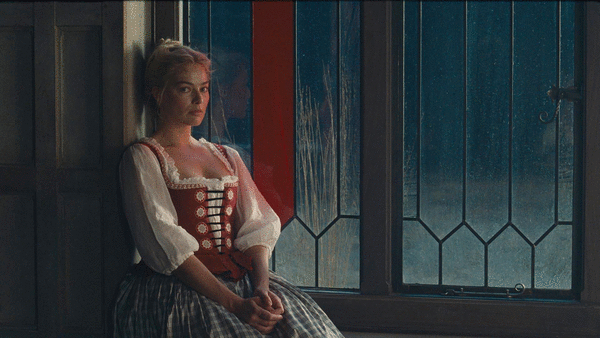
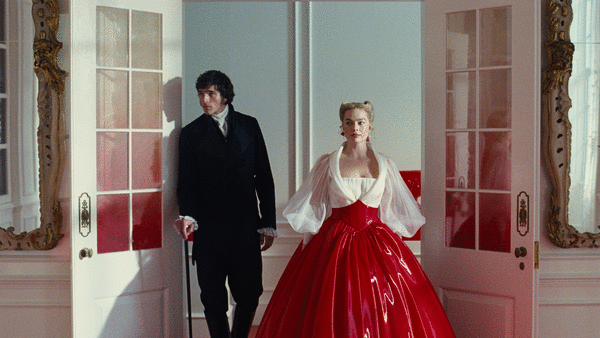


LOS ANGELES — In its opening credits, Oscar-winning director Emerald Fennell's "Wuthering Heights" self-identifies as "based on the novel by Emily Brontë."
Yet as Fennell has proven in a slew of interviews about the already polemical film, released Friday, the relationship between Brontë's Gothic epic and its latest adaptation is more complicated than that.
Penned by a young female author perpetually adrift in the dark world of fantasy, "Wuthering Heights" is a transgressive novel today and was exponentially more so at the time of its publication in 1847. Its protagonists are vengeful, and its romances — including Catherine Earnshaw (Cathy) and Heathcliff's — are ridden with violence, both psychological and physical. While Fennell's film anchors itself in Brontë's narrative landscape, it also takes creative liberties in service of approximating the director's personal experience reading it as a teen.
Whereas Brontë's novel contains "mere glimmers of physical intimacy," Fennell's picture is erotic, laden with steamy scenes inserted from the director's imagination.
"They're part of the book of my head," Fennell recently told The Times. "I think they're part of the book of all of our heads."
Some book purists beg to differ with Fennell's interpretation. Well in advance of the film's release, the director was criticized for casting her former "Saltburn" collaborator Jacob Elordi as Heathcliff, who is repeatedly described throughout Brontë's novel as non-white. Brontë fans have also accused the director of reducing a complex work rife with social critique into a popcorn romance.
Perhaps anticipating such backlash, Fennell in a recent interview with Fandango explained her decision to enclose the film's title in quotation marks, saying, "You can't adapt a book as dense and complicated and difficult as this book."
"I can't say I'm making 'Wuthering Heights.' It's not possible," the director said. "What I can say is I'm making a version of it."
Here are seven ways Fennell's interpretation of "Wuthering Heights" differs from its source material.
Fennell's Heathcliff is white
Brontë's "Wuthering Heights" leaves Heathcliff's racial identity ambiguous, with characters referring to him as a "gipsy brat," "lascar" and "Spanish castaway" at different points throughout the novel. But one thing is clear: He is not white.
As the Lousiana State Unversity professor Elsie Michie writes in the academic journal article, "From Simianized Irish to Oriental Despots: Heathcliff, Rochester and Racial Difference," Heathcliff's racial othering is how "he becomes, for others, a locus of both fear and desire." In other words, Heathcliff's role in the novel, and thus his fraught romance with Cathy, is predicated upon his non-white identity.
Fennell's film instead relies on class differences — and a meddling Nelly (to be discussed later) — to form the rift between its love interests.
Cathy's brother dies young
When Mr. Earnshaw presents a young Cathy with her companion-to-be early in the film, she declares that she will name him Heathcliff, "after my dead brother."
For the remainder of the film, Brontë's character Hindley Earnshaw is subsumed into Mr. Earnshaw. Rather than Hindley, it is Mr. Earnshaw who devolves into the drunk gambling addict whose vices force him to cede Wuthering Heights to Heathcliff. Mr. Earnshaw's abuse of young Heathcliff in the film makes the latter's revenge plot more personal than his book counterpart's against Hindley.
Cathy meets Edgar Linton as an adult
In Brontë's novel, Cathy and Heathcliff first encounter their neighbors, the Lintons, after an outdoor escapade gone awry. Cathy gets bitten in the ankle by an aggressive dog and stays at the Lintons' for a few weeks to heal.
Cathy sustains a similar injury in the film, but this time, she's an adult woman, who falls from the Thrushcross Grange garden wall after attempting to spy on its grown residents Edgar and Isabella. (In the book, the two are siblings. Here, Isabella is referred to as Edgar's "ward.")
Aside from providing some comic relief, Fennell's revision also fast-tracks the marriage plot that severs Cathy and Heathcliff.
Nelly is a meddler, and a spiteful one
Whereas Brontë writes Nelly as a largely passive narrator, Fennell abandons the frame narrative structure altogether and instead fashions the housekeeper into a complex character with significant control over Cathy's life.
It is she who ensures Heathcliff overhears Cathy as she laments how marrying him would degrade her, causing him to flee Wuthering Heights and leave Cathy to marry Edgar. Nelly's ploy comes shortly after Cathy demeans the housekeeper, claiming that she wouldn't understand Cathy's predicament given she's never loved anyone, and no one has ever loved her. Thus, Nelly is characterized as vengeful toward Cathy — although, as the latter lies in her death bed, the two share a brief moment that complicates their relationship to each other.
Regardless, Fennell gives Nelly and Cathy's relationship psychological depth that Brontë's novel doesn't seem to afford them.
Cathy and Heathcliff have sex (and a lot of it)
Brontë's Cathy and Heathcliff never explicitly (in the text) consummate their professed undying love, save for a few kisses just before Cathy breathes her last.
Fennell's "Wuthering Heights," on the other hand, grants them an entire Bridgerton-style sex montage — they even get hot and heavy in a carriage. It's nearly impossible to keep count of the "I love you's" exchanged during the pair's rendezvous.
These smutty sequences certainly validate the Valentine's Eve release.
Isabella is a willing submissive
One particular still of Alison Oliver's Isabella is already making the rounds online, and for good reason. The shot, which depicts the young woman engaging in BDSM-style puppy play, is a stark contrast to Brontë's characterization of Isabella as a victim of domestic violence.
In Brontë's book, Isabella marries Heathcliff naively believing he might shape up into a gentleman and flees with their son when she realizes that is out of the question. In the film, Heathcliff is clear from their first romantic encounter that he does not love Isabella, will never love her and pursues her only to torture Cathy — and the young woman still chooses to be with him.
There is no second generation
Perhaps Fennell's most glaring diversion from her source material is her complete omission of the second half of Brontë's novel, which centers on a second generation comprised of Cathy and Edgar's daughter Catherine Linton, Heathcliff and Isabella's son Linton Heathcliff and Hindley and his wife Frances' son Hareton Earnshaw.
In her introduction to the Penguin Classics edition of "Wuthering Heights," Brontë scholar Pauline Nestor writes that many literary critics interpret the novel's latter half as "signifying the restoration of order and balance in the second generation after the excesses and disruption of the first generation," while others contend the violence that stains Cathy and Heathcliff's relationship is bound to be replicated by their children. Either way, the structure of Brontë's novel encourages readers to interpret each half through the lens of the other.
Fennell's film instead ends where Brontë's first act closes, hyper-focused on Cathy and Heathcliff. In the same way the doomed lovers see each other, Fennell figures them as the center of the world.
©2026 Los Angeles Times. Visit latimes.com. Distributed by Tribune Content Agency, LLC.







Comments