Column: Banksy's anonymity is what gives -- gave? -- his art its power
Published in Entertainment News
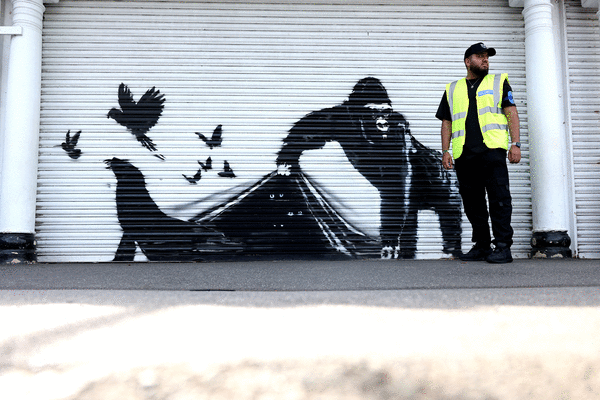
The revelation that the artist Banksy is a 50-something man from Bristol, England, named Robin Gunningham, according to a Reuters report, has shaken the art world. It may be the ultimate test of what actually determines value in contemporary art.
Art insiders are speculating that the news will increase the value of Banksy’s work. That line of thinking tracks with the fact that markets hate uncertainty, and now there is more clarity. But Banksy’s art is not like a stock option or any other commodity; greater transparency and predictability won’t increase its value. Odds are, the prices of his existing work will fall.
That said, it is easy to see how coming out of the shadows and embracing commercialization could create a new and more stable market for Banksy’s work — or at least more consistent revenue for art dealers who believe their role is to control price and supply. It is true that his work has fallen sharply in recent years, but so has the broader art market. The difference is in the magnitude: his prices tend to rise and fall more dramatically, often behaving like a high-beta asset.
Art has always been a peculiar market because value is so arbitrary — what determines it isn’t anything intrinsic to the work itself. Factors like aesthetics, scarcity, hype, and the sense that the work captures our cultural moment all shape value.
Contemporary art, or art produced by a living artist, is especially hard to price for several reasons. The artist may turn out to be a modern master, or they may flame out. Their work may not stand the test of time as the cultural moments and historical events that inspire it lose their immediacy. This is why prices are so volatile, and the market is prone to manipulation by dealers who, to their credit, aim to make value more predictable (albeit with conflicted incentives).
In part because of this dynamic, few contemporary artists are well-known outside of art circles. Those who are — like Jeff Koons and Damien Hirst — owe as much to hype as to the work they produce, with marketing and spectacle becoming part of the art.
This helps explain why Banksy may be the most famous living artist. His work, which is not especially exceptional on its own, would not be nearly as valuable if it didn’t capture the political moment. Indeed, timing and context have allowed his art to circulate beyond traditional art audiences. But Banksy’s success also points to a broader problem. Art at its best challenges and reflects the world we live in, often making us uncomfortable.
Much of what we see today falls short of those standards. Like many cultural institutions, contemporary art often mirrors a left-wing ideological perspective — about as edgy as an HR training video — that can come across as preachy and hypocritical. Banksy shares the political inclinations of the rest of the art world, but his anonymity and covert methods have made an otherwise unsurprising political message feel fresh.
From the shadows, he created a much-needed distance, positioning himself outside the systems he was critiquing. Consider that the artist claims to be challenging the capitalist system, yet once he is known, his position within that system becomes impossible to ignore. He could no longer covertly create his art without risking arrest for vandalism. He’ll need to be commissioned to create it like other street artists.
A known Banksy may produce the same work, but it would be fundamentally different and less unique than other products on the market. Remaining unknown helps sustain the hype, even long after he’s gone. Years from now, art historians would’ve written dissertations speculating about who he really was, further adding to the myth and, in turn, the value of his work.
But perhaps all is not lost. We know Banksy might be a middle-aged man from Bristol — emphasis on might. The artist still has not confirmed the news. If he stays mum about the claims, some of the mystery may still endure, which would be for the best. Without anonymity, his artistic power is likely to erode. The market for his work could become more stable, but at the cost of both value and excitement.
____
This column reflects the personal views of the author and does not necessarily reflect the opinion of the editorial board or Bloomberg LP and its owners.
Allison Schrager is a Bloomberg Opinion columnist covering economics. A senior fellow at the Manhattan Institute, she is author of “An Economist Walks Into a Brothel: And Other Unexpected Places to Understand Risk.”
©2026 Bloomberg L.P. Visit bloomberg.com/opinion. Distributed by Tribune Content Agency, LLC.









Comments