Commentary: What is the future of not-for-profit American theater?
Published in Entertainment News
Recently, Oskar Eustis, the artistic director of New York’s legendary Public Theater for the past 21 years, announced his plan to step down in 2028. Eustis has had a long career in American theater, and his opinions are well respected. That’s why his statement that “the not-for-profit theater movement is over” has generated a lot of responses.
The not-for-profit theater movement began in the 1960s led by theater artists who were frustrated by the commercial limitations of Broadway. They established professional theater companies around the country, focusing on classics, new plays and career opportunities for theater professionals. With the support of the Ford Foundation and National Endowment for the Arts, the movement grew rapidly, with an estimated 1,000 companies by the turn of the century.
The future looked bright. But major challenges emerged in the past two decades:
—It became clear that theater board members, who primarily work in for-profit industries, do not understand the economics of not-for-profit theater and the need for financial support beyond the box office (in part because there is a commercial for-profit segment of the industry). Simply put, with fixed capacity and appropriate compensation for theater professionals, either ticket prices must significantly increase (see Broadway prices), or subsidies are needed to fill the income gap.
—Major foundations in New York and around the country substantially cut back support for professional not-for-profit theaters. The result has been a significant loss of revenue, putting more pressure on theaters to increase individual contributions, which are costly to generate, adding to the expense of fundraising.
—Wealth holders of the new generation do not view the arts as a priority in American society. To the extent they engage in philanthropy, it tends to be focused on education, healthcare and social services.
—The philanthropic challenges resulted in enormous pressure on not-for-profit theaters to maximize box office revenue. This leads to risk-averse seasons, casting well-known actors, partnering with commercial producers (particularly on musicals) and using demand-based pricing.
—The pandemic had a devastating impact on all theaters, particularly those not-for-profit theaters, which immediately furloughed their artists and staff. As a result, it became difficult and more expensive for those theaters to reopen because many of their employees left the industry or demanded higher wages to return.
—In 2020, it became evident that many not-for-profit theaters were not accurately representing American society, as reflected in the lack of diversity in their leadership, boards, staff and programming. The tremendous turmoil this recognition created continues to reverberate in the industry.
Unless there is a major infusion of capital into the professional American theater, adventurous productions will only happen in small theaters with low or no wages for artists. This “after work” or “avocational” theater is well established in Chicago. This is not a criticism of these theaters — it simply is observing that artists and theater professionals who aspire to have careers working on new plays and productions will have far fewer opportunities.
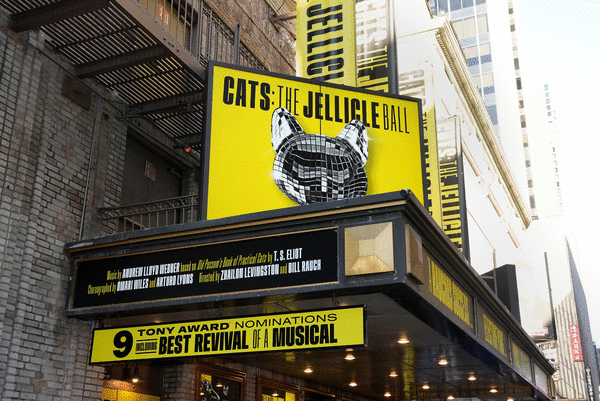
Major not-for-profit theaters will focus on accessible productions and commercial partnerships. For Broadway producers, it will continue to become more difficult given skyrocketing costs and the impact on ticket prices (the early closing of “ Cats: The Jellicle Ball” on Broadway over the economics is a recent example).
Is there a solution? Not-for-profit theaters and commercial producers should join forces to advocate for significant increases in financial support and tax incentives from all levels of government. The case for support should be focused on jobs. The labor-intensive theater industry is a job-creating machine with tens of thousands employed around the country each day. The full national impact of the jobs created and tax revenue generated by the American theater industry has not been documented. It would lead to a powerful case for support.
I had discussions with theater leaders about this initiative while I was at the Goodman. There was significant interest given the volume and potential political reach of not-for-profit and commercial theaters in the country. Plus, there is a precedent: Congress’ bipartisan decision that made the American theater industry eligible for COVID-19 relief funds. The political climate is difficult now but eventually will change, and the theater industry should be prepared.
I urge theaters leaders, particularly the heads of the League of Resident Theatres and the Broadway League, to pursue this initiative.
———
(Roche Schulfer worked at Goodman Theatre for 51 years, including 44 as executive director.)
———
©2026 Chicago Tribune. Visit at chicagotribune.com. Distributed by Tribune Content Agency, LLC.











Comments