
Ask the Builder: Using epoxy for exterior repairs
Several days ago I had a phone conversation with Wayne, a very good friend, after he and I completed our morning ritual Morse code conversation. He approached me at the ripe age of 74, wanting to learn Morse code. I took him under my wing, and now he’s very proficient.
He asked me about repairing a concrete curb in his rear yard. A chunk about the size of a baseball had cracked off. Wayne shared that he could place it back together and you would only see the fine line of the fracture. He wanted my advice about a great way to reattach it.
I recommended masonry epoxy.
There are all types. Some you can inject into cracks, some are translucent, some are like peanut butter. I’ve had success with every one I’ve tried. I did an almost identical repair to a small concrete garden sculpture a year ago. A small water feature figurine’s head cracked off. The epoxy repair is almost invisible.”
I convinced him to use the two-part epoxy that mixes with very little effort. All he would need would be a very thin coat on the fractured face of the concrete to bond the two pieces of concrete together for a very long time. The epoxy ends up stronger than the concrete itself, and it’s rated for exterior cold-climate exposure.
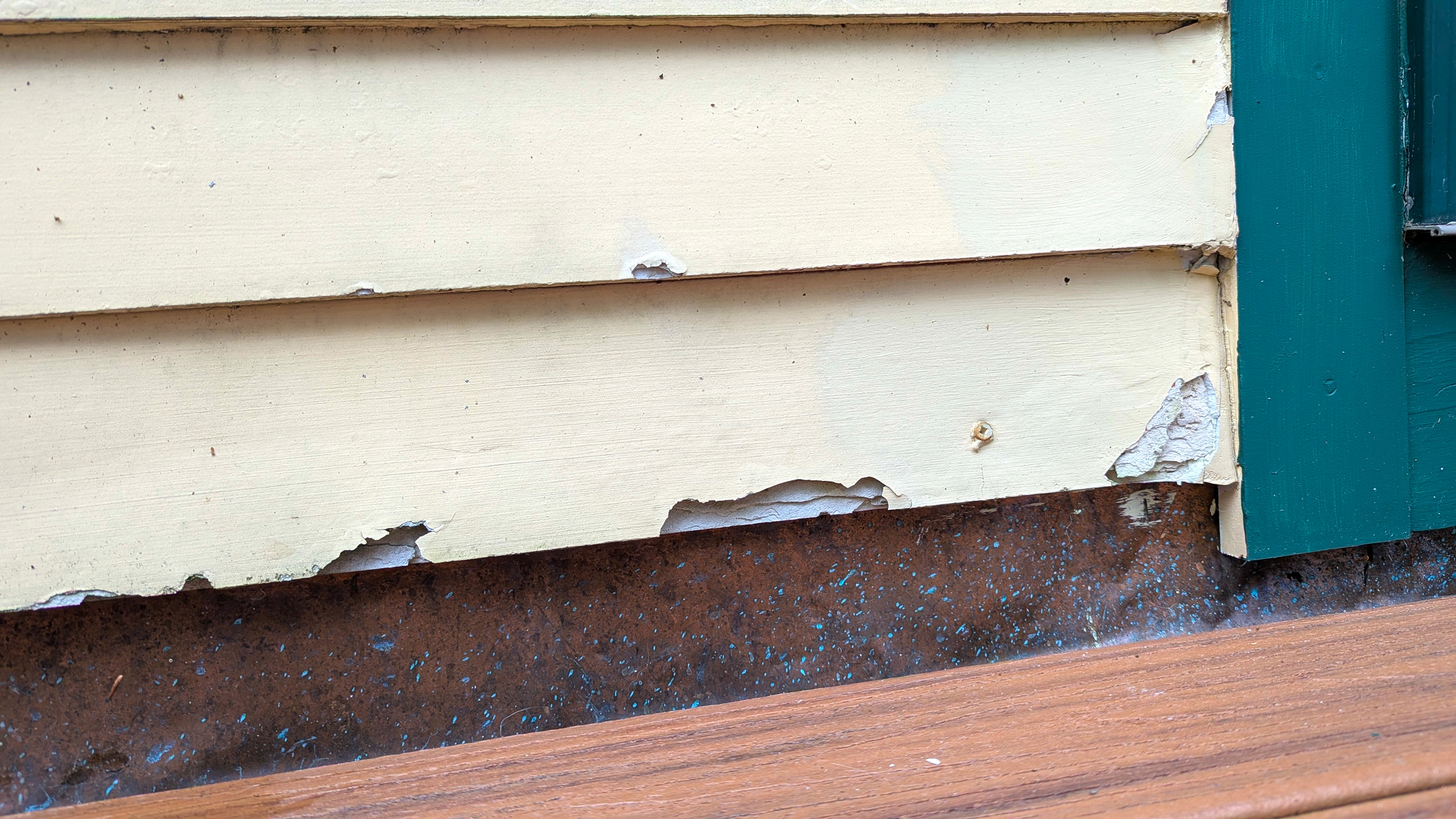
I’m about to use the same material to repair ice-damaged fiber-cement siding that’s adjacent to my deck. I live in central New Hampshire where winters are known to be cold, snowy, and icy. Ice-cold rain splashes up from the deck in December and gets the lower edge of the siding wet. The painter, I believe, never coated this edge of the siding. In his defense, it wasn’t an easy task, and without a mirror, you wouldn’t know whether you got good coverage.
Season after season, the water soaked into the siding and would freeze. The expanding ice was able to fracture the wood fibers used in the siding. If my house had the original fiber-cement siding of old that used asbestos fibers instead of wood, I’d not have to do the repair. There are no less than 10 old houses within five miles of my house that have this ancient durable siding. All of them have no frost damage to the lower row of the siding. The asbestos only poses a health hazard if you start to beat on it with a hammer, creating clouds of dust. Most people don’t do this to their siding, at least not here in New England.
My siding repair is the hardest of all. The epoxy I intend to use is thick, but it can sag. I plan to slide a piece of heavy-duty aluminum foil up behind the siding, leaving about 2 inches hanging below the bottom edge. I’ll bend that excess out away from the wall.
I’ll then wedge a straight 3/4-inch-thick board up against the bottom of the siding. This will act much like a form board a mason places when pouring a concrete sidewalk or driveway. I’ll then fold the aluminum foil over this form board. The foil prevents the epoxy from bonding to the form board.
Once the epoxy is applied and has cured, I’ll remove the form board after 24 hours. I’ll trim off any excess foil, lightly sand the epoxy, and paint it to match the other siding. It takes very little skill to get professional results.
The epoxies are not limited to masonry repairs. I’ve used an amazing two-part epoxy for rotted wood repairs. It’s important to note that the epoxy doesn’t take the place of the structural component of a piece of wood. It just seems to work much better than traditional exterior spackling products, especially if you have a deep repair.
The wood epoxy I’ve had the best success with also has a liquid wood hardener that’s used as a first step. Dry, rotted wood often is brittle like a saltine cracker. The liquid hardener is brushed onto the rotted wood. It soaks in and dries in hours, causing the wood to be far less brittle. This allows you to apply the epoxy without crushing the wood structure.
I love how easy it is to sand the wood epoxy. It’s perfect for exterior painted trim. Using an affordable orbital sander, you can make the epoxy silky smooth. Think of all the big holes, cracks, gouges, etc. that you can repair with this magic epoxy.
This wood epoxy is not meant for use with semi-transparent stains. The epoxy dries a solid putty color. If you’re trying to match the grain and appearance of real wood, you’ll have to do that on top of the epoxy using a wood-graining kit.
I know you want to know what epoxy I’ve used with great success. Here’s a link to both the masonry and wood epoxies that I’ve had the best luck with. Follow the instructions and you’ll do well too: https://amzn.to/4xuhAje
I’m available to hold your hand over the phone to do repairs using these two epoxies. Just use this link to set up a phone call: https://go.askthebuilder.com/coaching
Subscribe to Tim’s FREE newsletter at AsktheBuilder.com. Tim offers phone coaching calls if you get stuck during a DIY job. Go here: go.askthebuilder.com/coaching
©2026 Tim Carter. Distributed by Tribune Content Agency, LLC.



























Comments