The Politics of Comfort: How Soft Clothes Became a Cultural Statement
Published in Fashion Daily News
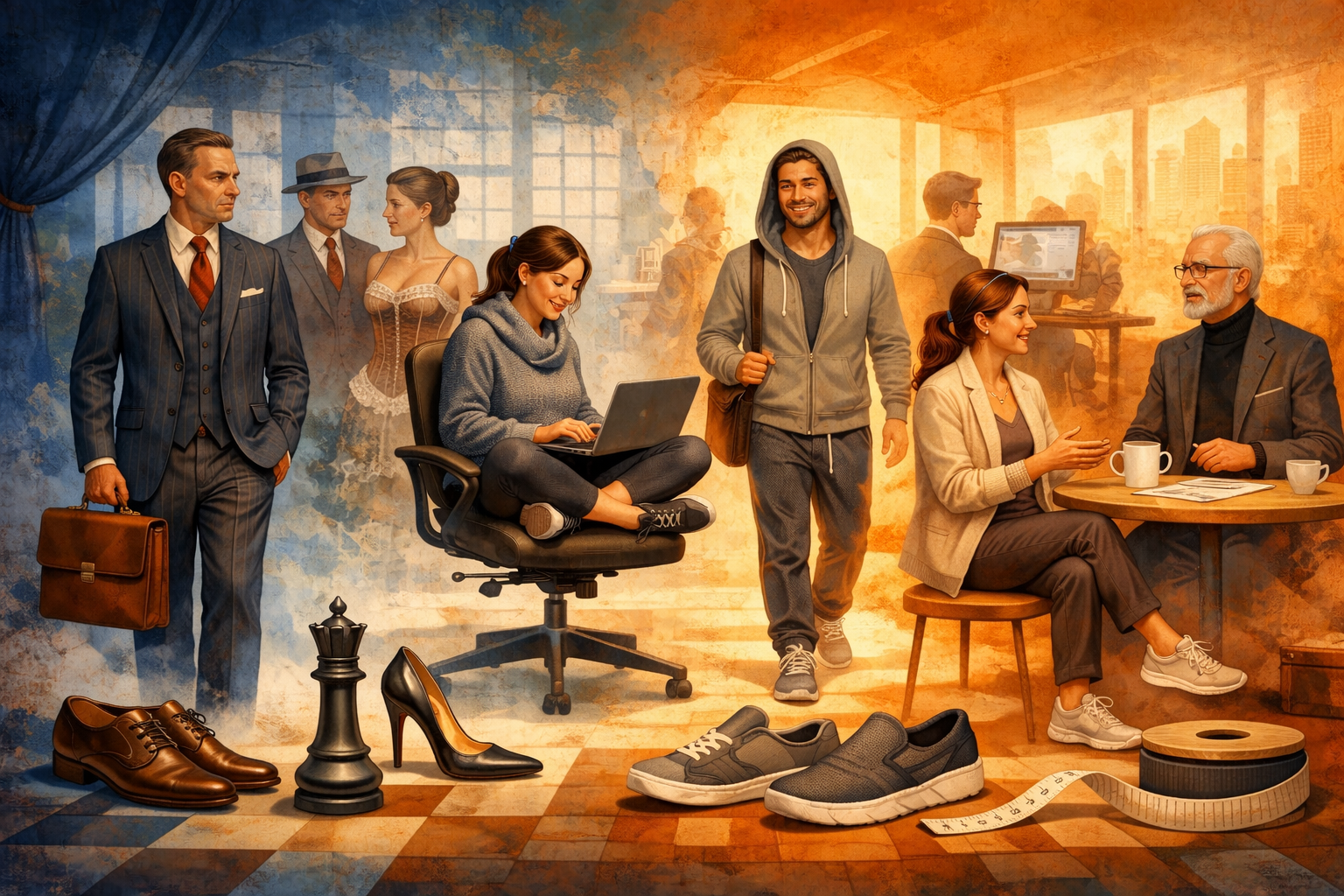
For much of modern history, discomfort has been framed as the price of respectability. Starched collars, rigid tailoring, high heels, tight waistbands and heavy fabrics signaled discipline and status. To be serious was to be structured. To be powerful was to endure.
But across offices, classrooms and city streets, that equation has shifted. Comfort — once coded as lazy or overly casual — has become both mainstream and quietly political. Elastic waistbands, cushioned sneakers and knit blazers are no longer confined to weekends. They have entered boardrooms and conference halls. The question is no longer whether comfort belongs in public life, but what it means that it does.
From Corsets to Casual Fridays
Historically, clothing has functioned as a form of social architecture. Nineteenth-century corsets shaped women’s bodies into silhouettes associated with propriety and restraint. Early 20th-century business suits standardized male authority through stiff wool and precise tailoring. In both cases, the body adapted to the garment.
The mid-to-late 20th century introduced cracks in that structure. Youth culture in the 1960s and 1970s challenged dress codes with denim, sandals and loose silhouettes. The 1990s brought “Casual Friday” policies that symbolically loosened corporate rigidity. Still, the underlying expectation remained: comfort was conditional and temporary.
The COVID-19 pandemic accelerated a transformation already underway. Remote work blurred the boundary between private and professional life. Millions conducted meetings in knit joggers and soft sweaters. As workers returned to offices, many did not abandon those preferences. Instead, they carried them back into formal spaces.
The Rise of Soft Power Dressing
Fashion analysts describe a shift toward “soft power dressing” — garments that retain a professional outline while prioritizing ease of movement and tactile comfort. Stretch fabrics replace rigid weaves. Blazers are cut in jersey instead of structured wool. Footwear that resembles athletic sneakers now appears in executive settings.
This shift is not purely aesthetic. It reflects changing workplace values. Companies emphasize collaboration over hierarchy and flexibility over rigid schedules. A wardrobe built around mobility mirrors that ethos.
For some, comfortable clothing represents autonomy. Choosing a knit dress over a tailored sheath can signal a refusal to equate discomfort with competence. For others, it simply reflects efficiency: if work is measured by output rather than posture, then clothing becomes a tool rather than a test.
Retail data supports the trend. Since 2020, global sales of athleisure and hybrid workwear have consistently outpaced traditional formalwear. Major brands have expanded lines featuring elastic waists, stretch materials and ergonomic construction. What was once a niche category now dominates seasonal collections.
Gender, Class and the Cost of Ease
Comfort is not distributed equally. Historically, rigid dress codes have burdened women more heavily, from restrictive footwear to shaping garments designed to meet narrow aesthetic standards. The normalization of flat shoes, breathable fabrics and inclusive sizing represents a material shift in daily experience.
However, the politics of comfort intersect with class as well as gender. In some industries, particularly law, finance and luxury retail, strict dress expectations remain markers of status. Expensive tailoring can itself signal privilege — the ability to afford custom garments that are both structured and comfortable.
Meanwhile, workers in service and manual labor sectors often wear uniforms dictated by safety or branding requirements, with limited autonomy over comfort. The cultural embrace of softness in white-collar environments does not necessarily extend across all economic strata.
The tension reveals an underlying truth: clothing communicates belonging. When comfort becomes normalized among leadership ranks, it can democratize appearance norms. But when softness is accepted only for certain bodies or job titles, it reinforces inequality.
The Psychology of Fabric
Beyond politics, comfort has measurable psychological effects. Studies in cognitive science suggest that clothing influences mood and performance — a phenomenon sometimes referred to as “enclothed cognition.” Wearing garments that feel good against the skin can reduce stress and improve focus.
Tactile sensation plays a significant role in emotional regulation. Soft fabrics, such as cotton knits or brushed fleece, can evoke feelings of safety and familiarity. During periods of uncertainty, consumers often gravitate toward these textures. The surge in loungewear during global crises reflects not just practicality but a search for reassurance.
At the same time, some professionals report that overly casual clothing can blur mental boundaries between work and rest. The balance lies in hybrid garments: structured enough to signal purpose, flexible enough to avoid constraint.
Redefining Professionalism
Perhaps the most significant shift is cultural rather than sartorial. Professionalism, once defined by visual uniformity, is being renegotiated. Younger generations entering the workforce tend to value authenticity and personal expression. For them, strict adherence to formal dress codes can feel performative.
Companies responding to recruitment pressures have relaxed policies accordingly. Tech firms led the transition years ago, but traditional sectors have followed. The sight of a chief executive in minimalist sneakers no longer shocks investors.
Critics argue that the erosion of formal dress risks diminishing gravitas. Supporters counter that credibility should stem from expertise and integrity, not stiffness of fabric. The debate underscores a broader recalibration of authority in the 21st century.
Comfort does not inherently oppose competence. Instead, it challenges the long-standing assumption that visible effort — even physical discomfort — is proof of seriousness. The shift invites a reconsideration of what signals commitment in modern life.
A Quiet Cultural Rebellion
Clothing rarely changes laws, but it reflects collective values. The embrace of comfort suggests a society reevaluating its relationship to productivity, identity and well-being. It asks whether pain and professionalism must coexist.
Elastic waistbands and cushioned soles may seem trivial, yet they carry symbolic weight. They represent a subtle resistance to outdated hierarchies and rigid norms. They prioritize bodies as living systems rather than mannequins for expectation.
As workplaces evolve and public life adapts, the politics of comfort will continue to unfold in closets and conference rooms alike. What people wear to work is no longer merely about fashion. It is about how they choose to inhabit their own bodies — and what they believe that choice should communicate.
========
Eliza Marrowfield is a staff writer covering culture, labor and design trends. She reports on how everyday aesthetics intersect with economics and identity. This article was written, in part, utilizing AI tools.





Comments