Editorial: Don't play God with Gulf sealife
Published in Science & Technology News
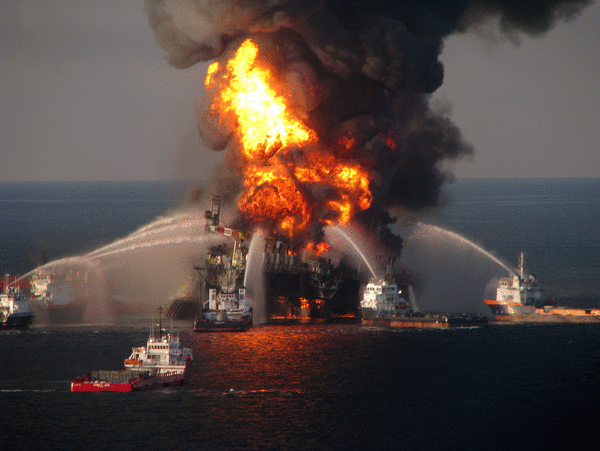
For decades, there’s been a quasi-clandestine accord about expanding oil drilling in the Gulf. Nobody wanted to go there — well, except the oil and gas companies aching to root around for black gold, and their most loyal minions in high places.
The idea of wherever-you-want drilling never made sense, for an array of reasons. Money was a key driver: The tourism-intensive east Gulf Coast economy would certainly suffer if tourists had to look at ugly oil rigs. Commercial fisheries and aquaculture — an increasingly important contributor to the U.S. food supply — would likely suffer. State leaders would be saddled with most of the risk, and very little of the reward, from additional oil and gas leases. And there’s compelling economic data showing that increased drilling won’t help much — if at all — to reduce fuel costs at the gas pump or on utility bills.
But the biggest, most glaring argument came in the still-vivid memories of the Deepwater Horizon disaster that killed 11 people, spewed nearly 5 billion barrels of oil into Gulf waters and sent oil-soaked birds, stranded sea turtles and dying baby dolphins washing up on shorelines from Tampa Bay to the Texas coast. This month marks the 16th anniversary of the disaster, and its impacts are still visible: Diseased fish and eyeless shrimp, decreased birth rates and calf survival among whales, decreased yield in critical, profitable fisheries. The spill is considered a major contributor to the 4,400-square mile “dead zone” where conditions are too toxic to support significant aquatic life.
Many of these arguments, however, boil down to competing interests. To people who see oil and gas production as a priority that overshadows all others — a group that includes the current occupant of the White House — another argument has held sway. “We can’t,” federal officials would groan when pro-oil forces started arm-twisting. “The Endangered Species Act. You know. So unreasonable but there’s nothing we can do.”
That packs one obvious truth — oil drilling has an unavoidable and long-lasting impact on marine life — with a big lie. In reality, the Endangered Species Act has never been used as the means to deny an oil-drilling lease. Only rarely has it been anything more than a speed bump, despite the fact that the Gulf is one of the most diverse and economically critical wildlife environments on the planet, with thousands of birds, fish, crustaceans, dolphins, turtles and other species calling it home.
So how did this 52-year-old law suddenly become a critical threat to national security, to the point where it needs to be totally nullified any time a new oil or gas lease is on the line? That’s the argument put forward by Secretary of Defense Pete Hegseth, who last week convened a rarely summoned group known informally as the “God squad” to approve an exemption from the ESA’s provisions for the oil and gas industry in the Gulf.
Even to some/many hardcore Trump supporters, Hegseth’s argument makes little sense: The law’s provisions But are a threat, he says, because environmental groups file lawsuits, forcing the oil industry to wake up its lawyers and go to court. But that hasn’t stopped U,S. oil production, which is at historic highs.
Even before the rule takes hold, people are mourning a probable casualty. Deepwater Horizon came close to destroying the population of the Rice’s whale, most often seen off the coast of the Florida Panhandle — but in the past decade, barely seen at all. Federal wildlife officials say there are probably 50 or fewer adults left in the wild. Stripping them of ESA protection will almost certainly finish the job.
And another critically endangered species might be at risk, as well. Right whales, with their characteristic drooping dorsal fin, are most often seen along the Eastern Seaboard, but over the past few years two of them were spotted in the Gulf, one with a calf. There are only about 380 right whales left. Someone needs to tell them to stay on the East Coast — at least, until the precedent set by last week’s action in the Gulf provides the basis for a similar rule along the East Coast, particularly in New England where the whales’ modest protections have inconvenienced commercial fishing boats.
In the long run, we suspect Hegseth’s new rule won’t even do that much to promote oil production. Taking away endangered-species protection won’t erase the myriad other arguments against offshore drilling. It just means the broad array of Republicans and Democrats alike, will lose an easy argument against offshore drilling.
If Hegseth’s real goal was to stop lawsuits, he’s already lost that battle as well. A coalition of environmental groups, headed by the nonprofit law firm Earthjustice, have already filed suit. If justice means anything any more, a federal judge will easily swipe through Hegseth’s nebulous legal fantasies, and preserve the possibility that someday, the Endangered Species Act might actually help save endangered species in the Gulf.
____
–The Orlando Sentinel Editorial Board consists of Opinion Editor Krys Fluker, Executive Editor Roger Simmons and Viewpoints Editor Jay Reddick. Use insight@orlandosentinel.com to contact us.
©2026 Orlando Sentinel. Visit at orlandosentinel.com. Distributed by Tribune Content Agency, LLC.






Comments