One week later, Artemis II astronauts grapple with weight of what they witnessed
Published in Science & Technology News
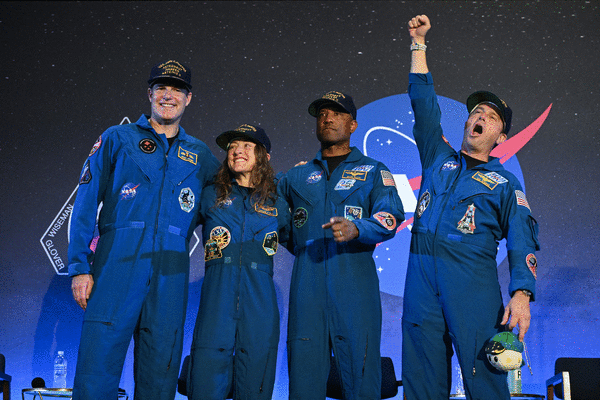
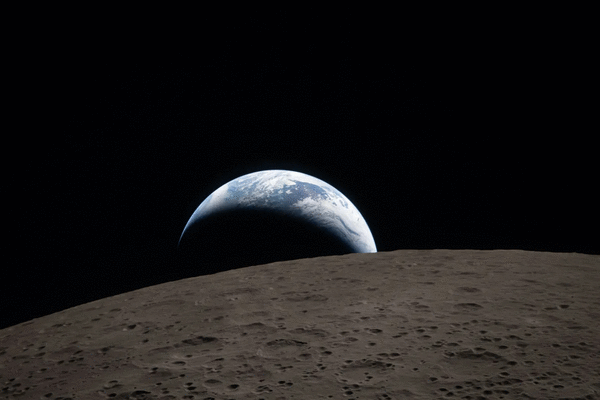

Days after their capsule splashed down in the Pacific, the four astronauts of Artemis II have had time to contemplate the gravity of their historic mission around the moon — but they still haven’t fully weighed what it all means.
“Where I keep coming back to is what kept grabbing my attention when the lighting was right and we were looking at the window,” said Canadian Space Agency astronaut Jeremy Hansen. “There’s depth to the galaxy that I just had never experienced before.”
During a press conference Thursday, Hansen, along with NASA astronauts Reid Wiseman, Victor Glover and Christina Koch, discussed some of their more emotional takes since their return to Earth.
They had just completed a 10-day mission that launched from Kennedy Space Center, riding the most powerful rocket to ever send humans into space. They flew around the far side of the moon, traveling farther from our home planet than any human ever had, and on their way home had witnessed a solar eclipse.
“I’m not really a religious person, but there was just no other avenue for me to explain anything or to experience anything. So I asked for the chaplain on the Navy ship to just come visit us for a minute,” Wiseman said. “When that man walked in, I’d never met him before in my life, but I saw the cross on his collar, and I just I broke down in tears. It’s very hard to fully grasp what we just went through.”
The mission continues, he said, with the quartet still amid medical and physical testing while completing the human science objectives of the mission.
“We have not had that decompression. We have not had that reflection time. So I’m basing this on what we saw and when the sun eclipsed behind the moon,” he said. “I turned to Victor and I said, ‘I don’t think humanity has evolved to the point of being able to the point of being able to comprehend what we’re looking at right now,’ because it was otherworldly and it was amazing.”
Glover, who said he is a religious man, concurred. But he said he’s still trying to sort it out, and has tried in the last week to “live in a little hole” without any news or social media.
“I haven’t had a chance to really unpack it all yet,” he said.
Hansen said his time in space challenged him for words. Seeing the stars, moon and Earth more profoundly in three dimensions brought on waves of emotion, he said.
“The sense I had was the sense of fragility and feeling small, infinitesimally small, but yet this very powerful feeling as a human being,” he said. “Small and powerless, but yet powerful together.”
Koch said that at first the crew didn’t get the sense from space of whether or not their mission was making a difference. But as they were able to have a few talks with their families during flight, it started to dawn on them.
“When my husband looked me in the eye on that video call and said, ‘No, really, you’ve made a difference.’ It brought tears to my eyes, and I said, ‘That’s all we ever wanted.'”
Having completed the journey, she’s starting to realize that there’s more to be expected than just attention from the NASA team.
“In the beginning three years ago, we were being celebrated for something that we hadn’t done,” she said. “Having put in the work and having seen our team’s successes, I think we’re ready to share in that inspiration and to celebrate it.”
She has been sleeping great, though, she added.
“We are tired, so I think our bodies are ready to accept any time zone of sleep that we offered,” Koch said.
But she still wakes up thinking she’s off-planet.
“I thought I was floating,” she said. “I truly thought I was floating, and I had to convince myself I wasn’t.”
_____
©2026 Orlando Sentinel. Visit at orlandosentinel.com. Distributed by Tribune Content Agency, LLC.






Comments