Lisa Jarvis: The push for lower US drug prices uses bad logic
Published in Op Eds
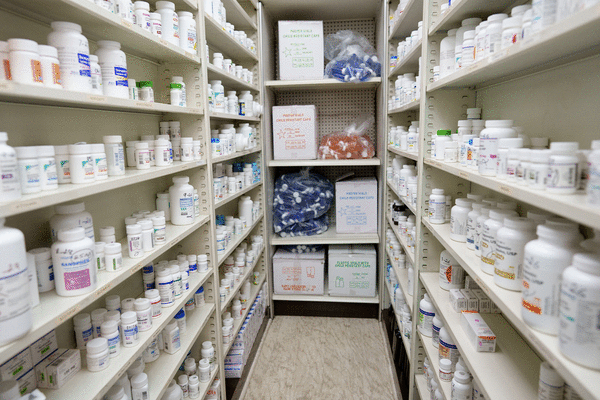
The need to address the high cost of prescription drugs is one of the rare areas of concordance in our divided country. Americans across the political spectrum can agree that seniors shouldn’t have to ration pills, cancer patients shouldn’t need a GoFundMe campaign to afford treatment, and that too many Americans are making steep sacrifices to pay for their medications.
With that backdrop, President Donald Trump’s yearlong focus on forcing a conversation — and better yet, action — on drug prices is commendable.
And yet, the details matter. The deals he has negotiated with Big Pharma companies look good on the surface, but it doesn’t take much digging to reveal their flaws. A major one is that the government has ceded the task of deciding how much drugs should cost to other nations.
The Trump administration’s stated goal for the dealmaking was to correct the imbalance in drug pricing between the U.S. and peer nations. The president’s argument for so-called most favored nation pricing dates back to one made in his first term: Other countries are benefiting while the U.S. shoulders the cost of innovation.
Government and private insurers in the U.S. often pay two to three times as much as peer nations for medicines that are invented here, a situation that Trump has long described as “global freeloading.”
An executive order the president signed in May asked companies to voluntarily slash prices paid by Medicaid to the lowest level paid by peer countries and to integrate most favored nation pricing in setting prices for new drugs. Failure to comply would result in steep tariffs on their products.
That strong-arming worked. For the past several months, Trump has staged splashy press conferences, with Big Pharma executives lining up to publicly commit to changing their ways. More recently, quieter deals from two additional manufacturers have left Regeneron Pharmaceuticals as the last holdout among the 17 targeted companies.
All of the pacts look more or less the same: In exchange for tariff relief, companies agreed to match Medicaid prices to those paid by peer countries, to invest in research and manufacturing in the U.S., and to sell certain drugs at a discount on the planned direct-to-consumer website TrumpRx.
That might sound like a win for patients and taxpayers. But, as I’ve explained before, the lack of concrete details about the benchmark being used — the prices paid by other countries are confidential — makes it nearly impossible to evaluate the deals. Earlier legislation is already working to reduce Medicaid drug costs, meaning the U.S. might already be getting a better deal than its peers. Most Medicaid patients, meanwhile, pay only a few dollars for their prescriptions.
It’s also easy to imagine how countries and companies could game the system. Manufacturers, for example, could raise list prices abroad, making the benchmark the U.S. uses appear higher, while quietly offering backdoor discounts. And with many new drugs launching in the U.S. before other countries — early access that has greatly benefited American patients — health policy experts question which benchmark the administration expects to rely on.
But beyond the many unanswered questions about the substance of the deals is the flawed premise on which they are based — one that the Trump administration appears intent on extending into more corners of the drug-pricing universe, including by codifying them. The underlying assumption is that the U.S. should rely on other nations to determine the value of medications taken by Americans, rather than determine that value for ourselves.
Many of the countries the U.S. considers peers have universal health care systems and far lower overall health care costs, which can dramatically change how a drug’s value is assessed. “We would potentially have a different set of values that we care about and potentially pay more for those products because we think they're important,” says Benjamin Rome, a physician and health policy researcher at Harvard Medical School.
He points to the example of the heart failure treatment Entresto, which in previous years cost Medicare about three times as much as peer nations paid. But an analysis by Rome and his colleagues found that the higher cost was offset by the savings of keeping patients out of the hospital — savings that would be unlikely to accrue in countries where inpatient care is cheaper.
Meanwhile, the U.S. has a much higher prevalence of certain diseases, particularly chronic conditions like diabetes and obesity, which can further change the value placed on a meaningful therapeutic advance — or even an incremental one.
None of this is to suggest that the astronomical cost of health care in the U.S. or the system’s emphasis on treatment over prevention aren’t problems in desperate need of fixing. Rather, it is to say that we should price drugs based on the system in which they are delivered.
That would require developing a thoughtful, transparent process for evaluating the cost-effectiveness of drugs — something peer nations with lower prices already have.
“Let’s have a serious and reasoned conversation about what drugs are worth here in America, and let’s develop an American system for aligning prices with value as we perceive it, rather than trying to take a shortcut, which ultimately doesn’t benefit American patients and their families,” Darius Lakdawalla, chief scientific officer at the University of Southern California’s Schaeffer Center for Health Policy & Economics, said at a recent KFF event.
Such a process could also improve other areas where the Trump administration is already negotiating prices. Despite frequent criticism of former President Joe Biden’s landmark Inflation Reduction Act — which, for the first time, gave Medicare the power to negotiate drug prices — bargaining has continued under Trump. The most recently agreed-upon prices are expected to save the government roughly $12 billion.
Yet that negotiating process also lacks transparency and predictability, leaving stakeholders guessing where future prices will land. Lakdawalla argues that this uncertainty ultimately harms innovation by making it impossible for companies to predict how the government will ascribe value to their products.
It’s also worth noting that Medicaid isn’t the only area where the Trump administration is applying a most favored nation approach. The Centers for Medicare & Medicaid Services last month launched two pilot programs that will peg both drug prices and rebates in Medicare “to costs in comparable countries.” The five-year test programs will apply to about one-quarter of the more than 66 million Medicare recipients in the U.S.
The Trump administration’s laser focus on drug pricing is welcome. But the president should also trust that American ingenuity extends beyond the invention of new medicines. The U.S. is plenty capable of developing its own well-considered system for making sure those drugs are affordable, too.
_____
This column reflects the personal views of the author and does not necessarily reflect the opinion of the editorial board or Bloomberg LP and its owners.
Lisa Jarvis is a Bloomberg Opinion columnist covering biotech, health care and the pharmaceutical industry. Previously, she was executive editor of Chemical & Engineering News.
_____
©2026 Bloomberg L.P. Visit bloomberg.com/opinion. Distributed by Tribune Content Agency, LLC.

















































Comments