Supreme Court tariff ruling puts federal revenue forecast on shaky ground
Published in Political News
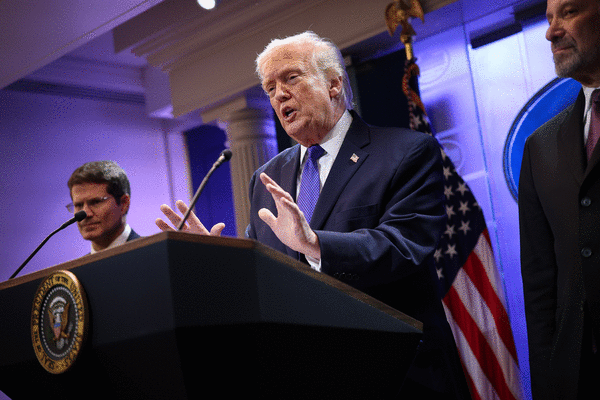
WASHINGTON — The Supreme Court’s ruling against President Donald Trump’s worldwide tariffs threw a monkey wrench into budget projections that assumed a hefty spike in tariff revenue to help reduce federal deficits. But at least in the short term, a replacement tariff regime may keep that bucket from leaking too much.
The high court on Friday ruled that the president exceeded his authority under the International Emergency Economic Powers Act of 1977, which gives him the power to impose tariffs under certain conditions in national emergencies or foreign conflicts. Trump had relied on that law to impose tariffs on Canada, Mexico and China, as well as “Liberation Day” tariffs worldwide.
The 6-3 decision upended that regime and put much of Trump’s initiative in doubt, though the president vowed to turn to other laws to replace the tariffs that were struck down. Trump said the new regime would begin with a global 10 percent tariff under Section 122 of the Trade Act of 1974 that he planned to impose through an executive order later on Friday.
“The Supreme Court did not overrule tariffs. They merely overruled a particular use of IEEPA tariffs,” Trump said at a Friday news conference. “But that’s OK, because we have other ways, numerous other ways … a president can actually charge more tariffs than I was charging in the past.”
The ruling came a week after the Congressional Budget Office forecasted that higher tariffs — much of which were imposed under the IEEPA law — would reduce federal deficits by nearly $3 trillion over 10 years.
According to the CBO, 41% of custom duties were imposed under the law last year. The tariffs have collected north of $133 billion so far, figures from Customs and Border Protection show.
The CBO also said it expects the administration “could replicate most of the tariffs imposed under IEEPA using alternative authorities,” though they noted in their report that there is uncertainty surrounding further actions.
Trump’s new 10% tariff under Section 122 is aimed at reducing trade deficits and would be imposed on top of other existing, non-IEEPA tariffs. The statute allows this authority to be used for only 150 days — unless Congress grants an extension, which seems unlikely — and allows for a maximum 15% tariff.
But during that time the president said he’d trigger more tariff investigations under a separate part of the 1974 law, Section 301, that he’s used before to target the practices of specific countries.
Trump said existing tariffs on imports within certain industry sectors on national security grounds, under Section 232 of the Trade Expansion Act of 1962, will remain in place. The CBO said Section 232 tariffs are responsible for much of the extra tariff revenue collected during Trump’s term thus far aside from the IEEPA duties.
Additional Section 232 investigations are already under way at the Commerce Department and more could be triggered, Trump said.
A recent analysis from the Budget Lab, a nonpartisan policy group at Yale University, estimates that the recent ruling would erase more than half of projected revenue increases from fiscal 2026 to fiscal 2035, reducing the revenue total to roughly $1.2 trillion during that time frame. And after accounting for slower economic growth, the net revenue haul would shrink to $1 trillion.
The Committee for a Responsible Federal Budget, another independent research group, estimated the ruling will put the country “about $2 trillion deeper in the hole” over 10 years and called on lawmakers to “work to quickly replace at least that amount.”
Two other think tanks, the Tax Foundation and the Tax Policy Center, estimate the IEEPA tariffs would have brought in around $1.4 trillion over a decade, before accounting for negative economic growth impacts.
Trump said his replacement tariffs could potentially generate even more revenue.
“We’re going forward, we’ll be able to take in more money,” he said Friday. “The numbers could be far greater than the hundreds of billions we’ve already taken in.”
During a separate speech Friday in Dallas, Treasury Secretary Scott Bessent said Trump’s imposition of Section 122 tariffs combined with “enhanced” use of other trade authorities “will result in virtually unchanged tariff revenue in 2026.”
Senate Minority Leader Charles E. Schumer, D-N.Y., vowed to oppose any replacement tariffs that Trump may consider.
“He is imposing new tariffs that will still raise people’s costs and they will hurt the American people as much as his old tariffs did,” Schumer said in a statement. “Donald Trump is doubling down on hurting American families by raising their costs.”
Congressional action
While Congress could act to codify the tariffs, the task is easier said than done. Democrats have staunchly opposed the tariffs, which they’ve argued are inflationary and contribute to economic instability.
Sen. Bernie Moreno, R-Ohio, proposed on X shortly after the ruling that Republicans codify the tariffs through a second budget reconciliation bill. The cumbersome reconciliation process, which avoids the risk of a Senate filibuster, allowed Republicans to pass last year’s major tax and spending cuts package with zero Democratic support.
The Supreme Court’s “outrageous ruling handcuffs our fight against unfair trade that has devastated American workers for decades,” Moreno wrote. “These tariffs protected jobs, revived manufacturing, and forced cheaters like China to pay up.”
Speaker Mike Johnson, R-La., also wrote on X following the ruling that “Congress and the Administration will determine the best path forward in the coming weeks.”
But Trump’s tariffs have divided Republicans, with some expressing a willingness to join Democrats in seeking to curb them.
Earlier this month, three House Republicans voted with Democrats to hamper a White House effort to block lawmakers from ending his emergency tariffs.
And prospects for passing a second reconciliation bill appear dicey at best. GOP leaders have treaded cautiously on the plan, saying it wasn’t clear what the bill would contain that could muster near-unanimous Republican support.
The more likely avenue for rescuing the tariffs would lie with Trump, who could try to use other executive powers for imposing them.
In another complication from the court ruling, the government could be on the hook for refunding the more than $133 billion in IEEPA tariffs already paid. Over 100 companies have filed lawsuits seeking refunds.
“Refunds of billions of dollars would have significant consequences for the U. S. Treasury,” Supreme Court Justice Brett M. Kavanagh wrote in his dissent from the majority opinion. “The Court says nothing today about whether, and if so how, the Government should go about returning the billions of dollars that it has collected from importers.”
Within hours of the court ruling, two House Democrats unveiled legislation Friday that would provide automatic refunds on tariffs paid since last year. The unnumbered draft bill, sponsored by Steven Horsford of Nevada and backed by Rep. Janelle Bynum of Oregon, would require refunds within 90 days of the bill’s enactment without the need for individual applications or formal protests.
Trump did not specifically commit to refunding IEEPA duties during his Friday news conference, instead suggesting he’d let the matter be decided in court — which could take years.
_____
Peter Cohn contributed to this report.
_____
©2026 CQ-Roll Call, Inc. Visit at rollcall.com. Distributed by Tribune Content Agency, LLC.
















































Comments