What the Supreme Court ruling on gender identity means for students, parents and schools
Published in Political News
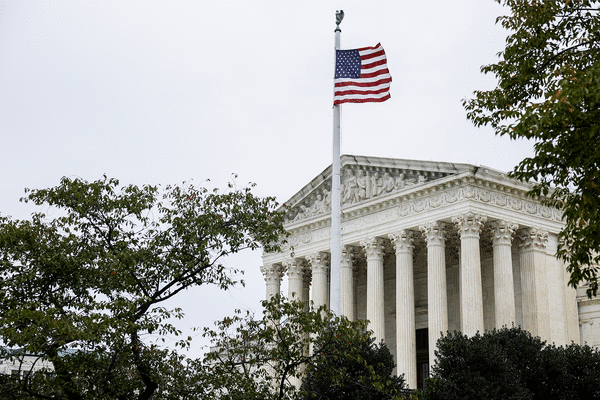
The Supreme Court’s ruling Monday affirming the right of parents to know about their child’s gender identity at school has left California educators with complicated questions about how to protect the sometimes competing rights of students, school employees and family members.
The Supreme Court decision in Mirabelli v. Bonta, while falling short of explicitly deciding the case, will have a sweeping impact because the court majority strongly agreed with a lower court’s interpretation of parent rights that differs from common practice in California.
“Ultimately, the issues are about the right of parents to be informed as opposed to the ability of the state to protect the privacy rights of children,” University of California, Berkeley law professor Erwin Chemerinsky said. “The Court, 6-3, comes down in favor of the former.”
The court majority sided with U.S. District Judge Roger Benitez, based in San Diego County, and against an appellate panel that stayed Benitez’s ruling pending the outcome of an appeal. The Supreme Court action allows crucial portions of Benitez’s ruling to go into effect while the appeals process plays out.
In his Dec. 22 decision, Benitez ruled that parents have a federal constitutional right to know of LGBTQ+ issues affecting their children at school. Moreover, he said teachers had free speech and freedom-of-religion rights to tell parents about their child’s gender-identity issues if the teacher wanted to do so. The case originated with teachers who were trying to assert such a right. Parents joined the lawsuit later.
The Supreme Court did not lift the stay related to employees. So, it’s not clear what teachers have the right to say to parents who don’t inquire about the issue, legal experts said. However, if parents want to know, school employees must tell parents whether, for example, a student is exploring a different gender identity at school.
Benitez’s original court order also bars school districts from “misleading” parents related to “their child’s gender presentation at school.” School employees are prohibited from “directly lying to the parent, preventing the parent from accessing educational records of the child, or using a different set of preferred pronouns/names when speaking with the parents than is being used at school.”
In addition, Benitez gave state officials 20 days to show they notified school districts of the ruling. That 20-day deadline was put on hold by the appeals court, but presumably the countdown has resumed — or is about to.
This deadline puts immediate pressure on the California Dept. of Education to comply and — importantly — to provide guidance to the state’s 1,000 school systems. But on Monday, the department was not ready to do so, responding only that it did not comment on pending litigation.
The office of state Attorney General Rob Bonta, which pursued the appeal, expressed disappointment.
“We remain committed to ensuring a safe, welcoming school environment for all students while respecting the crucial role parents play in students’ lives,” the statement said.
California school districts are left in a difficult, legally precarious position, said Edgar Zazueta, executive director of the Assn. of California School Administrators. State law, for example, prevents a school district from forcing a teacher to “out” an LBGTQ+ student to a student’s parents against that student’s will.
“The Supreme Court’s action changes the immediate legal landscape for school districts, but it does not resolve the broader legal questions at issue,” Zazueta said. “We are urging state officials to provide timely guidance.”
The governor’s office sharply rebuked the court’s action.
“Teachers should be focused on teaching — not forced to be gender cops,” said Marissa Saldivar, a spokesperson for Gov. Gavin Newsom.
Both sides say they emphasize student safety and parent involvement. The parents-rights conservatives maintain that threats to students are best handled through law enforcement and the courts. California lawmakers have wanted to give educators more discretion.
Supreme Court sides with religious parents
In its ruling, the Supreme Court majority had to decide what was more urgent while the case worked its way through the court system: extending the right of parents to control the raising of their children, including their religious instruction; granting rights to teachers and other school employees to talk freely to parents on gender issues, or maintaining the current balance of student and parents rights as practiced in California.
According to data cited in the original ruling, at least 598 of the state’s 1,000 school systems have policies restricting what parents can be told about their child’s gender expression at school — if the child requests confidentiality. State officials argued that the ruling would cause administrative chaos across California and also would threaten the privacy rights and living situations of LGBTQ+ students who do not have supportive families.
However, the greatest urgency, the Court majority decided, is safeguarding how parents choose to raise their children.
These parents “have sincere religious beliefs about sex and gender, and they feel a religious obligation to raise their children in accordance with those beliefs,” the majority opinion states. “California’s policies violate those beliefs.” Also, the opinion said parents should not be excluded from an important mental health issue.
The court’s six conservatives were in the majority of the unsigned opinion, while the three liberals dissented.
Justice Elena Kagan wrote in a dissent joined by Justice Ketanji Brown Jackson that the court received “scant and, frankly, inadequate briefing about the legal issues in dispute.”
She added: “The application of existing law to the case raises tricky questions ... The Court is impatient: It already knows what it thinks, and insists on getting everything over quickly.”
Sharp divisions in reaction
Analysts at California Policy Center, a think tank closely allied with conservatives, said state officials would be wise to fall in line quickly.
While the Supreme Court did not issue a final ruling, CPC vice president Lance Christensen said,“ the highest court in the land just telegraphed how they are likely to rule.”
Shannon Minter, legal director at the National Center for LGBTQ Rights, called the Supreme Court’s action “deeply alarming.”
“Without full briefing or oral argument, the Court has effectively greenlit the forced outing of transgender students to parents — even where the evidentiary record shows that disclosure threatens significant psychological, emotional, and physical harm,” Minter said.
He added: “Schools adopted these privacy protections for a reason: because for some students, being outed at home means abuse, rejection or worse.”
©2026 Los Angeles Times. Visit at latimes.com. Distributed by Tribune Content Agency, LLC.
















































Comments