Foes gear up to counter Trump's possible election moves
Published in Political News
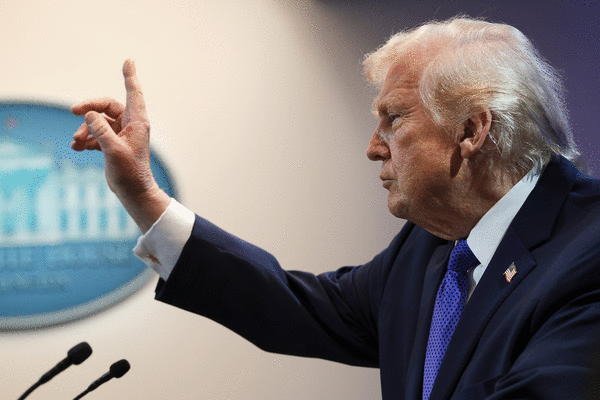
WASHINGTON — President Donald Trump was nonchalant last week when asked about a contested administration rule that would use the U.S. Postal Service to weed out allegedly illegal midterm election ballots. His foes say that’s all part of a broader plan, even as they offered few surefire ways to stop it.
Trump was asked last Thursday specifically about the fate of the rule, which was since frozen by a federal judge, since North Carolina planned to send ballots out in eight days. Trump began his answer with: “North Carolina is great. It’s a great place. I won it all three times.”
He then said of the proposed Postal Service rule and mail-in ballots: “We want to make them legitimate.” But, a day after the Supreme Court appeared to give the rule a new life, Trump appeared to signal a partisan intent, telling reporters in the Oval Office: “And it was a great ruling for the Republican Party.”
A federal judge in Massachusetts a day later again blocked the rule as the administration prepares a high-stakes appeal. As that legal battle plays out, some congressional Democrats and outside groups are gearing up to counter a broader White House program to overhaul how elections are administered.
Congressional aides and leaders of some of those groups interviewed in recent days said the proposed Postal Service rule is only one part of what one source described as a “kaleidoscope” of moves already taken or floated by the administration. Each said Trump’s shrugging off of the Postal rule’s possible impact on North Carolina’s ballot plan was part of a confusion campaign.
“It’s just one more part of the White House’s strategy to create and sow confusion about elections,” said the director of one voter advocacy group, granted anonymity to be candid. “They want to sow doubt about how folks will be able to vote, no matter how they’re trying to take control of elections and voting — either legally or illegally or on the margins.
“So I wouldn’t say there’s one biggest threat. It’s really all of it. We’re seeing an unprecedented willingness to use the vast resources of the federal government to interfere in our elections,” the voter advocacy organization leader said. “We see them looking at the elections process as a continuum. So that’s voting lists maintenance, early voting, mail-in voting, the (vote) counting and tabulations. And even interfering in seating the winners. All the president’s actions and current rhetoric shows this president is willing to use the levers of the federal government to interfere in our elections.”
Trump and other administration officials have said their midterms moves and possible actions fall within the boundaries of existing laws. The president has said publicly on a number of occasions that Democrats have used mail-in ballots to “cheat.”
He has not provided legitimate evidence of foul play, however.
“You cannot have mail-in ballots, people will cheat,” he told Las Vegas television station KVVU, an affiliate of the typically friendly Fox network, on Aug. 5. “And we have to get rid of mail-in ballots.” (Trump himself has voted via mail in his home state of Florida.)
Congressional Democrats and elections-rights advocates said Trump’s March 25 executive order on elections signaled an intention to ramp up federal actions related to elections. Key parts have been blocked by multiple courts.
Still, the missive directed federal agencies to tighten election rules by requiring documentary proof of citizenship for the national voter-registration form, expanding federal/state access to citizenship and voter-roll data and prioritizing enforcement against noncitizen voting and other election violations. It also sought to require Election Day ballot-receipt deadlines, impose election-system security and paper-ballot standards, condition some federal funding on compliance and end federal actions implementing Biden administration voting-access actions.
Sources involved in pushing back on the administration’s elections program acknowledged there was little, at this point, they could do to block the proposed Postal Service rule.
A federal government whistleblower, however, via a disclosure submitted to Sen. Richard Blumenthal, D-Conn., the ranking member of the Homeland Security and Governmental Affairs Permanent Subcommittee on Investigations, contended the ballot-verification system USPS would use under the rule could leave tens of thousands of legitimate voters without mail ballots before the Nov. 3 election, according to The Washington Post.
White House officials contend the administration has abided by each court decision about the USPS rule.
Asked about the whistleblower’s allegations, White House spokesperson Lauren Bis said in an email that “the process of building software to carry out this new verification check is neither complex nor unique for USPS since the Postal Service regularly uses bulk mailing and intelligent mail barcodes for a wide variety of large customers,” adding: “Under President Trump, the federal government is working to ensure safe, transparent, and honest elections.”
‘Closely contested’
Members of a Senate Democratic elections task force, including California Sen. Alex Padilla, have contended there are actions they can take to counter other possible administration actions.
A major thrust will be to educate elections officials about potentially illegal orders from federal officials or agents that they should not follow. Sources said that will include meetings with local law enforcement to notify them of existing elections laws and steps they might need to take to intervene. And litigation, where it is deemed necessary.
Padilla’s office recently briefed reporters on the most likely administration moves around the midterms, citing possible deployments of federal agents near polling stations, potential attempts by federal officials to seize ballots and possible attempts to intimidate election officials. (The call’s ground rules were that no aides could be named and no direct quotes could be used.)
Padilla’s office and outside sources said they have been planning a sprawling education campaign geared, in large part, at state and local elections officials. But part of that effort banks on a gamble administration foes are making: Several sources said they doubt even elections officials in states and districts Trump has carried three times would want murky or illegal outcomes in races they oversaw.
For instance, Wyoming’s Republican Gov. Mark Gordon last week asked the state attorney general to investigate how two U.S. Justice Department officials monitored poll workers and observed voters in Laramie County during the Cowboy State’s Aug. 18 primary, the Associated Press reported.
The Senate Democratic task force for the first time plans to deploy teams of election observers, and Padilla’s office told reporters it expects to send out about 10 such groups. That would be dwarfed by the 1,000 Trump-loyal monitoring groups the Justice Department has said it intends to deploy.
The House also has traditionally sent out observer teams, and the voter advocacy director said outside groups would send their own teams. That director said there would be a calculated effort to have observer teams positioned for the most competitive House and Senate races.
“We are very much looking to see where the threats are more likely to take shape, based on whether it’s expected to be a closely contested election, and the prevalence of election deniers in key positions in those locations,” that source said. “We’re also looking at whether other kinds of local rules are in place that might lend themselves to attacks by the administration.”
Still, cracks are visible among the administration’s foes.
An aide to the director of one organization involved in efforts to counter the White House elections program said her boss was too busy for an interview due to a book tour.
A former senior Federal Elections Commission official who now heads a nonprofit said through an aide that the voting-focused organization would not be commenting on any administration moves ahead of the midterms.
“We need to take the threats seriously. While I understand the temptation to not take everything this administration says seriously given its record of bluster, we need to be prepared to take this seriously,” the voter advocacy director said. “We’ve heard from members of both political parties saying they’re concerned and asking what they need to do.”
_____
©2026 CQ-Roll Call, Inc., All Rights Reserved. Visit cqrollcall.com. Distributed by Tribune Content Agency, LLC.





































Comments