Wildfire bill to ease path for controlled burns passes Senate
Published in Political News
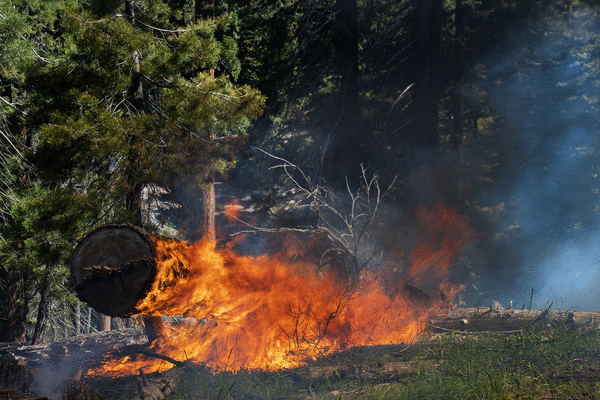
WASHINGTON — The Senate passed legislation that would amend the Clean Air Act to ensure states would not be penalized for conducting prescribed burns intended to prevent larger, uncontrolled wildfires by unanimous consent on Tuesday.
Under current law, states are required to meet air quality standards for particulate matter pollution. Controlled burns can increase this pollution, and while these are technically “exceptional events” that wouldn’t count toward whether a state is in compliance, states have said they face a high administrative burden of proof.
Sen. John Curtis, R-Utah, the bill’s lead sponsor, described the measure as “one of the most effective ways” to reduce hazardous fuels and prevent catastrophic wildfires.
“With every passing day, the threat to our communities, our lands, and our very lives grows more severe. That is why it makes no sense to leave a critical tool like controlled burns off the table,” he said on the Senate floor on Tuesday.
He said the data is clear that wildfire containment and prevention is “far more successful in areas where prescribed burns took place,” yet states can face regulatory consequences for doing so.
The measure would require the EPA to propose revisions to regulations that would make it easier for states to demonstrate a prescribed fire is an exceptional event.
Sen. Jeff Merkley, D-Ore., said on the floor that while his constituents would have once opposed prescribed burns, many now support the practice with the hope that it may help avert events such as the 2020 Labor Day fires in Oregon that burned more than 1 million acres.
“Prescribed burns are, along with thinning and mowing, significant ways to reduce the fuel load and reduce the devastation when there is a fire,” said Merkley. “They say an ounce of prevention is worth a pound of cure. That’s a pretty good foundation for a bill.”
Merkley also highlighted a provision in the bill that would establish a grant program to prevent, control or abate wildfire smoke hazards in community buildings, including schools.
The Senate Environment and Public Works Committee approved the measure earlier in September on a 19-0 vote.
It now faces negotiations with the House, which passed a competing bill in April that would also change how prescribed burns are treated under the CAA.
Introduced by Rep. Gabe Evans, R-Colo., most of that chamber’s Democrats voted against that bill because it would also expand the list of exemptions from CAA compliance reporting to weather events like droughts, heat waves and stagnant air masses — which they argued was too big of a loophole.
The push for legislating on the growing wildfire crisis gained steam earlier this summer when smoke from blazes across the Western U.S. and Canada knocked at Congress’ front door when it polluted Washington for days, making it hard for senators to ignore the national threat.
Curtis noted that his home state of Utah has experienced a historic wildfire season, with more than 500,000 acres burned in one of the nation’s driest states, causing the worst wildfire season since 2007, according to J. Bradley Washa, an assistant professor of wildland fire science at Utah State University.
“The people of Utah are not looking for an emissions loophole. They are looking to protect their families, communities, and land,” Curtis said. “This is about recognizing that an ounce of prevention is worth a pound of cure.”
_____
©2026 CQ-Roll Call, Inc., All Rights Reserved. Visit cqrollcall.com. Distributed by Tribune Content Agency, LLC.



































Comments