Trump faces widening GOP backlash over Russia sanctions waiver
Published in Political News
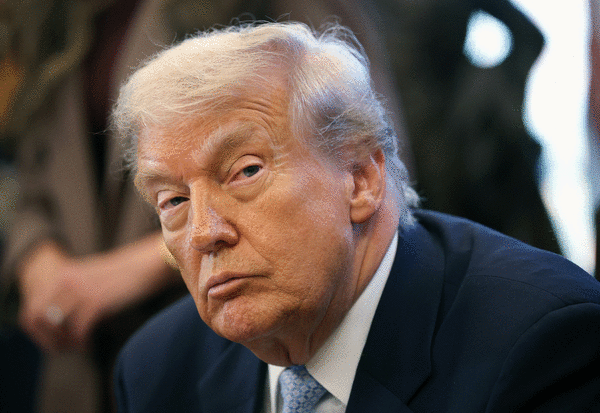
Republican lawmakers, including some of the president’s strongest allies on Capitol Hill, blasted Donald Trump for waiving new tariffs and sanctions on Russia, prompting the president to defend himself against members of his own party.
House Speaker Mike Johnson, in a rare sign of disagreement with Trump, said Sunday he asked for consultations with the White House, citing Russian President Vladimir Putin as someone who “cannot be trusted.”
GOP critics said Trump’s decision trampled on the will of Congress, which overwhelmingly passed a sanctions law last month championed by the late Senator Lindsey Graham, and would aide Moscow’s war effort against Ukraine.
Trump issued the waiver shortly after cutting a deal with Russia on diesel exports aimed at lowering high fuel prices ahead of the U.S. midterm elections, in which the cost of living is voters’ dominant concern.
“I told the White House team that we need to talk about it and and I think carefully consider the the unintended consequences that that may ensue from that,” Johnson said on Fox News’ "Sunday Morning Futures."
Senator Kevin Cramer, a Republican from North Dakota, recalled visiting Kyiv this month as part of a congressional delegation that met with Ukrainian President Volodymyr Zelenskyy. “Capitulating to a bully” won’t work, Cramer said Sunday on CBS’s "Face the Nation," referring to sanctions concessions to Putin and calling for stronger measures to support Ukraine.
Senator Dave McCormick, a Pennsylvania Republican, said providing relief to Russia is “a bad idea” but gave Trump credit for trying to lower fuel prices. “That’s the tension,” he said on "Fox News Sunday."
Trump reaffirmed his stance on waiving the sanctions on Saturday, telling reporters “it’s a very good decision. And it’s going to be a decision that’s good for the country and I think good for the world.”
The decision by Trump threatens to open up a new rift between the White House and its congressional allies with Republicans in grave danger of losing their majorities in the House and Senate in the Nov. 3 elections.
That didn’t prevent more Republicans from questioning Trump’s stance on Sunday television shows. Representative Mike Turner called for a congressional investigation into Ukraine’s complaints that its use of SpaceX’s satellite technology was restricted. “Lives are at risk and lives are lost over these things,” the Ohio Republican told "Face the Nation."
Senator Ted Cruz, a Texas Republican closely allied to Trump, said Saturday that the administration should have found other ways to lower fuel costs, such as importing more from Canada or waiving renewable-fuel requirements.
“I wish the president hadn’t done it, I think it was a mistake,” Cruz said on Fox News, referring to Trump’s executive order late Friday waiving the Graham law. “The current path, unfortunately, just benefits Putin.”
Asked about Cruz’s criticism, Secretary of State Marco Rubio defended the decision and said Trump needs the 60-day waiver to “sort of study all this and figure out what the right combination is.”
Rubio also claimed the decision was about more than U.S. energy prices, acknowledging that the conflicts in Iran that have affected the Strait of Hormuz, between Saudi Arabia and the Houthis, and between Russian and Ukraine were putting constraints on global energy supply.
“These conflicts around the world are starting to crash into each other, and they’re having an impact not just on global oil and diesel prices, but on economics,” Rubio told reporters. “The diesel that Putin is going to sell, they would make it available to the global market one way or the other. The only difference is how much of it the United States was going to get.”
At least 10 Republican senators, along with several of their House counterparts, have spoken out against Trump’s diesel deal with Russia or the sanctions waiver.
“What part of enforcing a law passed 86-11 by the Senate does the President and his advisors not understand?” Senator Thom Tillis, a North Carolina Republican retiring at the end of his term, wrote Saturday in a social media post. He said Trump could lower energy prices by addressing Iran rather than “doing a solid for Vladimir Putin.”
A bipartisan group of 12 senators sent Trump a letter earlier last week urging him to rescind his diesel deal with Russia and enforce the Graham law. The Republican signatories included Tillis, Mitch McConnell, John Cornyn, Susan Collins, Alan Armstrong and Lisa Murkowski.
“Allowing Russian-origin diesel into global markets will offer limited to no relief to Americans,” the senators wrote in the letter, arguing the revenue would help finance Russia’s war in Ukraine and deepen Moscow’s cooperation with China, Iran and North Korea.
Darline Graham, who was appointed to fill her late brother’s seat and is running for a full term, said she plans to speak to Trump when he visits South Carolina this week.
“The president and I share the same goal, which is to end the war and get gas and diesel prices down. The sanctions bill is one of the tolls he can use to do that. It’s up to him whether or not he chooses to do so,” she told reporters on Saturday. “Personally, I would keep the pressure on Russia to end the war and get the gas prices down because I don’t trust Putin and I don’t trust Russia.”
While Ukraine has broad support on Capitol Hill, Congress is out of session through the midterm elections, so there’s little prospect of immediate action to block Trump’s diesel deal.
His plan to return Russian diesel to U.S. and global markets is expected to have little immediate effect on prices. A sustained resumption of Russian exports by year-end, however, could help shrink global supply deficits, provided Moscow can meet its commitments despite Ukrainian drone strikes on refineries.
Jeanne Shaheen, the ranking Democrat on the Senate Foreign Relations Committee, joined six other senators last week on a letter opposing the decision, saying Congress “explicitly banned Russian energy imports in 2022 to prevent American dollars from financing Putin’s brutal war against Ukraine.”
House lawmakers are also moving against the deal. A group of Democrats and one Republican introduced legislation Friday to block Russian diesel imports, though passage would be difficult in the Republican-controlled Congress and could require overcoming a Trump veto.
Representative Don Bacon, a retiring Nebraska Republican, cosponsored the bill. Representative Brian Fitzpatrick, a Pennsylvania Republican facing reelection in a contested seat, has separately said he would propose legislation barring purchases of Russian oil.
“Many of us won’t fund these things knowing he is propping up a dictator’s invasion and throwing an ally under the bus,” Bacon wrote in a social media post Saturday.
Democrats have almost unanimously opposed Trump’s overtures to Putin, and Zelenskyy has criticized the waiver, saying Saturday it might open the door to broader sanctions relief for Moscow.
_____
(With assistance from Steven T. Dennis and Katrina Manson.)
_____
©2026 Bloomberg L.P. Visit bloomberg.com. Distributed by Tribune Content Agency, LLC.






































Comments