A year after Trump's tax bill, rural Minnesota is still tallying the cost
Published in Political News
BRICELYN, Minn. — Last summer, President Donald Trump’s signature tax law cemented his administration’s policy legacy, driving down taxes for individuals and businesses and cutting social welfare benefits for people with no kids or low incomes.
A year later the tax law barely registers on campaign commercials ahead of November’s midterms.
In this small Minnesota town, residents can’t name the benefits. But they can count up the losses.
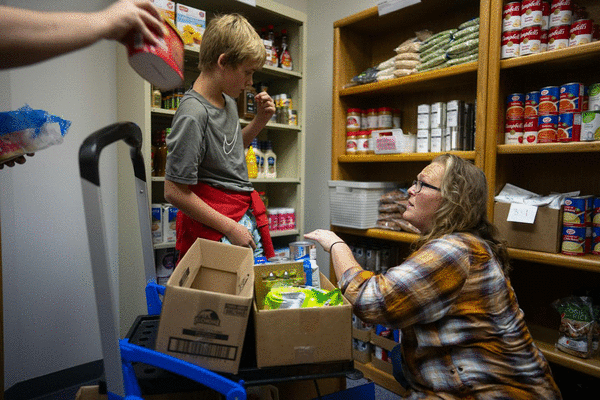
The busiest time in town used to be when pick-up trucks lined main street for the plate-sized pancakes at Bud’s Cafe. Today it’s the two hours on Thursday when the local food shelf is open.
The economies in Minnesota’s small towns, like their urban counterparts, have struggled to keep up with the rising costs of living. Yet many of the provisions in last year’s massive federal budget bill, like cuts to SNAP and Medicaid, with an estimated 140,000 Minnesotans expected to lose coverage, will have an outsized negative effect on rural communities.
When Trump signed the bill in 2025, the law helped Minnesotans with tax breaks and farm subsidies, but it also slashed federal spending on food and health programs, dialing up financial pressure on counties, cities and hospitals to find ways of offsetting those diminished funds. Even now, people are still trying to figure out if they were winners or losers.
“In our small, postage-stamp of a community, (cost of living is) affecting everybody,” said Bricelyn City Councilman Jason Anderson, who said he hasn’t voted for a Democrat since President Bill Clinton. “We just don’t want to feel forgotten.”
On a Thursday in early October, with the sun drifting behind a grain elevator slowly filling with harvested soybeans, a dozen people line up outside the food pantry on Bricelyn’s main street before 4:30 p.m. That’s when the doors open to piles of baskets and wheelbarrows of food, donated for local residents to make it through another week.
Tiffany Isaac-Ruiz, co-founder of the Bricelyn Food Pantry, noticed an uptick since the Republican tax bill was passed and signed last year. She says they had to limit the number of people and still distributed 14% more food than the year earlier.
“When the bill passed, we did see a surge,” said Isaac-Ruiz. “We saw the need increase.”
To offset the big tax cuts for business and individuals, Congress had to cut federal programs. High on that list was U.S. Department of Agriculture’s Supplemental Nutrition Assistance Program (SNAP). The program, which offers debit cards for lower-income Americans to spend on food, was cut by $187 billion.
Bricelyn exists in a food desert. The closest supermarket is 17 miles away. The town’s only cafe and small food mart closed in February.
The population, and the food pantry’s customer base, includes older residents who grew up when the town had a school, newspaper and cannery, as well as Latino families who moved in for the affordable houses in town but worked elsewhere.
On the first Thursday night in October, clients weaved between cartons of fresh squash and shelves of blue boxes of macaroni and cheese. In a cooler, donated ears of corn and jugs of milk were neatly stacked — an oasis of fresh food.
“It’s really stressful for people living on Social Security, or one paycheck to the other,” said Bradley Ystenes, who drives over from Twin Lakes. He’s a union carpenter, but work never really rebounded after the 2008 recession. “(Cost-of-living) doesn’t stretch your budget. It shrinks your budget.”
In the legislation, Congress enacted nearly $1 trillion in cuts to Medicaid, the federal anti-poverty health program, by adding work requirements that many recipients won’t complete.
Colin Planalp, associate director for Emerging Health Policy Issues at the University of Minnesota, said the cuts will disproportionately hurt rural areas where higher shares of residents get insurance through Medicaid or Medicare.
They could also add pressure onto rural hospitals, already disappearing from the landscape, Planalp said.
Health care in Bricelyn doesn’t look like it once did. Mayo Clinic closed the clinic in nearby Wells in 2025. The hospital in the county seat of Blue Earth, about 20 minutes west, is the only nearby birthing center after the Mayo-owned hospital in Albert Lea stopped delivering babies in 2019.
United Hospital District, in Blue Earth, declined a request for comment for this story. But UHD CEO Rick Ash said at a press conference in St. Paul this week that the cuts slated to start in Medicaid in 2027 will “be like a pandemic when it hits.”
One Bricelyn woman, who asked that her name not be used while discussing personal medical information, said she moved from the Pacific Northwest to an affordable home in southern Minnesota to be closer to Mayo Clinic for her youngest son’s treatments of a rare genetic disorder.
She fears an older son, also on Medicaid, will lose access on Jan. 1, when work requirements come into play. The law requires people to more frequently document that they worked over 20 hours a week to get Medicaid coverage. The son works up to 25 hours a week, but his employer has been cutting hours.
For her Bricelyn family, the cuts to health and SNAP restrictions are a double-whammy.
“It’s a good community filled with really nice people,” the woman said. “But it sucks having to drive for everything. As far as I know, the only food in town is the food shelf.”
In an Oct. 7 debate, Republican U.S. congressman Brad Finstad said that the cuts he voted for were “common-sense, Bill Clinton-era welfare-to-work reforms.” His opponent, DFL-endorsed Rochester math teacher Jake Johnson, said government could spend efficiently “without taking food out of the mouths of hungry people.”
Finstad said cutting benefits was required to secure the law’s tax benefits. “When you go to Congress, Jake,” Finstad said, “there isn’t a ‘maybe’ button. There is a ‘yes’ or a ‘no.’”
Minnesota counties are now scrambling to pay for a larger chunk of both Medicaid and SNAP costs.
Because Minnesota is one of the states that administers SNAP at the county level, Congress’ decision to shift federal spending to the states meant the burden fell directly to the counties here.
Minnesota counties began paying more of SNAP’s administrative costs in October, prompting County Commissioner Bruce Anderson and other commissioners statewide to look for ways to balance out the new spending requirements with the county’s mission to serve residents.
Bricelyn sits in heavily agricultural Faribault County, which President Trump won in 2024 by 37 points. Anderson said he doesn’t like unfunded mandates, whether they come from St. Paul or Washington.
Faribault County and neighboring Martin County, which jointly administer SNAP and Medicaid, anticipate needing to pay an extra $1 million annually beginning in 2027 to cost hikes from the OBBB.
In September, the county set a preliminary levy for 2027 at $19 million, a nearly 15% hike that will be felt by property owners.
“We’ve been looking line-by-line,” said Anderson. “We don’t want to cut the services. But there gets to be a point where there’s nothing you can do.”
The business community broadly supported the OBBB when it was passed.
The U.S. Chamber of Commerce said over 60% of small businesses polled supported provisions in the law such as permanent expensing for big capital purchases and deducting taxes on research costs.
While businesses have evaporated from Bricelyn’s downtown over the years, there are bright spots. South of town, Goette Farms saw sales quadruple in 2025 for its direct-to-consumer beef and lamb business. Now Erika Goette and her husband, Brandon, have hired three delivery drivers and two part-time warehouse workers.
Erika Goette said she didn’t specifically notice the impact of the tax cuts, in part because it’s hard to tell whether revenue came from the reforms or a growing business.
“I remember our accountant tax guy talking at a 1,000-foot level about some things,” Goette said.
The disconnect cuts to the heart of a problem for Republicans this campaign season, as they try to hold up policy wins on Capitol Hill, but feel drowned out by anger around data centers, diesel prices and tariffs.
One aspect of the law’s reforms — a tax cut for tipped income earners — remains popular. Even Democrats like U.S. Senate candidate Gov. Peggy Flanagan said they could support that part of the law.
But in Bricelyn, the town cafe has closed. The waitress who worked there in the final days didn’t want to talk about it. Now even to buy a pancake, residents need to leave town.
_____
©2026 The Minnesota Star Tribune. Visit startribune.com. Distributed by Tribune Content Agency, LLC












































Comments