As Microsoft is cut from green card program, workers have questions
Published in Business News
Once again, a Trump administration blow to the H-1B program is rattling the Seattle-area tech workforce.
Vice President JD Vance announced Thursday that the Trump administration would suspend Microsoft from sponsoring workers on H-1B status for green cards.
The unprecedented move has potentially significant implications for one of the Seattle area's biggest employers. Like most tech companies, Microsoft has long relied on the H-1B foreign worker program to hire many of its employees.
The suspension raises concerns over whether the company will able to retain many of its H-1B workers beyond the program's six-year limit. For affected workers, it puts their ability to stay in the U.S. in jeopardy.
While the company swiftly disputed the claims behind the suspension, questions emerged Thursday whether the ban is within the administration's powers.
In theory, it is.
That's the neat thing about being a federal agency, you can deal yourself lots of authority," said Stuart Anderson, executive director of the National Foundation for American Policy, a research organization focused on immigration and trade.
To sponsor a worker for a green card, an employer must first submit what's known as a permanent labor certification application. This process is meant to verify that hiring the foreign worker won't affect wages or job opportunities for U.S. workers.
When an employer is suspected of potential fraud, the Department of Labor can suspend all permanent labor certification applications associated with that employer, Anderson said.
Vance said Thursday that the H-1B visa program has “become rife with fraud," although the White House has not provided evidence of fraud by Microsoft.
Those most affected by Thursday's announcement are workers who were just about to begin the process of getting sponsored for permanent residency.
It would also make other companies think twice about hiring H-1B workers and sponsoring them for green cards.
Most major tech companies already have offices abroad. In the long run, they'll simply shrink their presence domestic and expand in other countries, predicts Madeline Zavodny, an economics professor at the University of North Florida who has studied the H-1B workforce.
In Thursday's announcement, Vance characterized H-1B workers at Microsoft as "foreign indentured servants" who had replaced laid-off Americans.
But Anderson argued that it's not unusual for companies to make layoffs in one department while also hiring in another. He also pushed back against the idea that it's cheaper for Microsoft to hire H-1B workers.
"It would be a lot easier for for every company if they just hired U.S. workers," he said. "They wouldn't have to go through all the additional legal and administrative processes, plus opening yourself to being attacked."
'Constant barrage'
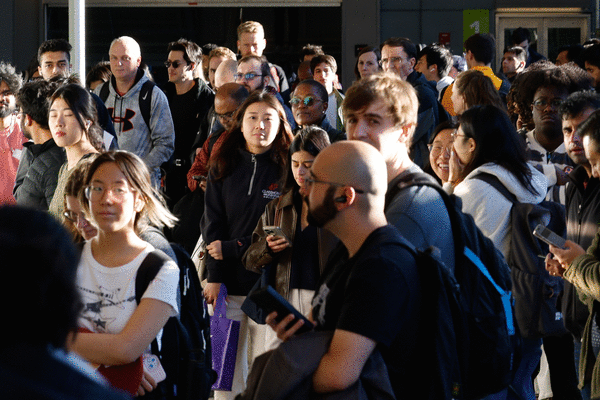
At Microsoft's headquarters in Redmond, employees grappled with how the suspension would affect the company. Some were worried for their friends and colleagues. Others were resigned, numb to the the administration's attacks on foreign worker programs. Employees on H-1B status were surprised by the news and unsure about whether the new rule would affect them.
"This constant barrage of immigration news, it adds to the general anxiety, said one employee, a software engineer who has been at the company for eight years. This software engineer and others who spoke with the Seattle Times Thursday requested to remain anonymous out of fear of jeopardizing their employment or their immigration status.
He doesn't think that he'll be personally affected by Microsoft's suspension, because his own permanent labor certification application has already been approved.
But he has other worries. Because the employee is from India, he faces a decades-long wait for a permanent residency due to nation-based green card caps. If he gets laid off, he's worried that he'll have to move back to India, a place his American-born daughter has never lived in.
Another worker said that he was worried for his friend, who is currently in the middle of the green card process. He was pessimistic about the suspension's impact on the economy.
Some said that there was a kernel of truth in the Trump administration's criticism of the H-1B program. Because workers' legal status is tied to their employers, they might feel reluctant to push back against heavy workloads. But they emphasized that work environments vary by company.
The Trump administration has taken a hostile approach to the H-1B program, enacting a series of changes that make it harder for workers to obtain and keep their status.
There was a new $100,000 fee for H-1B applications filed from outside the country, currently tied up in litigation; canceled consulate appointments that left many H-1B visa holders stranded abroad; a proposal to eliminate the 60-day grace period that H-1B workers have to stay in the country after getting laid off.
This week, the Department of Homeland Security announced a whopping $70,000 fee for international students to work in the U.S., a common career stepping stone for new graduates.
(Business reporter Alex Halverson contributed to this story.)
©2026 The Seattle Times. Visit seattletimes.com. Distributed by Tribune Content Agency, LLC.





Comments