Iran's supreme leader killed in US and Israel attack
Published in News & Features
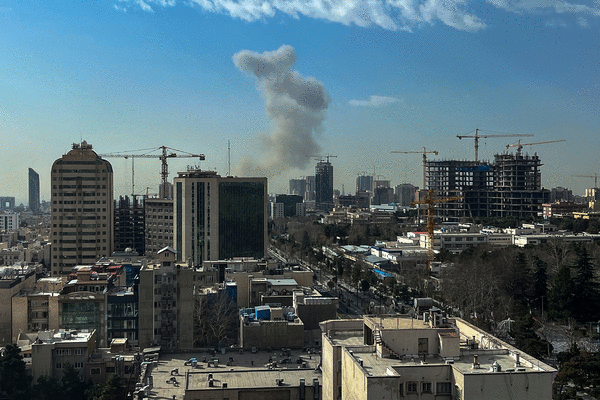
TEHRAN, Iran — The U.S. and Israel pummeled Iran early Saturday in an attack aimed at razing the Islamic Republic’s nuclear ambitions and thwarting its efforts to influence the Middle East though proxies such as Hezbollah and Hamas.
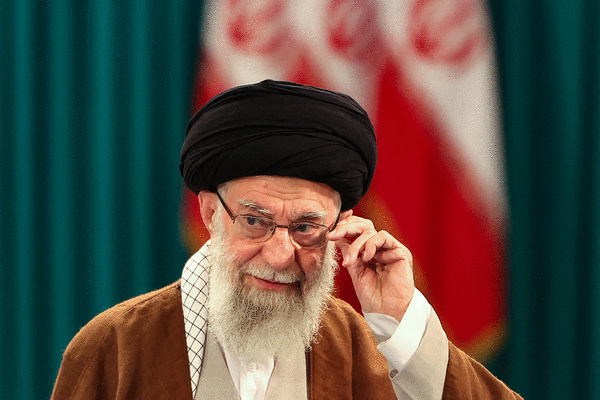
Iran’s Supreme Leader Ayatollah Ali Khamenei was killed in the attack, according to President Donald Trump, who in a post on Truth Social wrote that “one of the most evil people in History, is dead. This is not only Justice for the people of Iran, but for all Great Americans.”
More than 200 people were killed in Iran and hundreds more injured, according to Iran’s Red Crescent.
The attacks spurred a furious Iranian retaliation, with multiple barrages striking Israel, a number of gulf nations and Jordan; and fulfilled long-standing fears that a confrontation with Iran would plunge the entire region into war.
Reports of Khamenei’s death prompted diverse reactions worldwide: In portions of Tehran and Los Angeles, home to a large Persian population, people took to the streets to celebrate. In New York, protesters gathered at Times Square to denounce the attack.
The attack came eight weeks after U.S. forces deployed by Trump toppled Venezuelan President Nicolás Maduro, and Trump said Saturday’s operation also presented a chance for regime change.
Addressing the Iranian people, Trump said, “When we are finished, take over your government. It will be yours to take.”
Trump made the comments in an eight-minute prerecorded video. “This will be probably your only chance for generations,” Trump said, adding, “For many years, you have asked for America’s help, but you never got it. No president was willing to do what I am willing to do tonight.”
The Iranian government confirmed Khamenei’s death.
The attacks began with Israeli strikes Saturday morning — a workday in Iran — on Tehran, the capital, with residents speaking of attacks near Khamenei’s compound, the presidential palace, Iran’s National Security Council, the ministries of defense and intelligence, the Atomic Energy Organization and a military complex.
In Tehran there were scenes of panic, with residents racing to stock up on supplies, leaving shelves bare in grocery stores across the city. Others, heeding warnings from authorities of further strikes, decided to leave the capital. Images on social media showed highways leading out of Tehran choked with traffic.
“It’s going to take 10 hours at least, but it doesn’t matter,” said Zainab, who was loading her car with whatever she could stuff inside for the drive to her sister’s home in Iran’s northeast.
By the end of the day, the streets of Tehran appeared all but abandoned, with residents hunkering down for a night punctuated by the sounds of blasts reverberating across the capital.
Israeli Prime Minister Benjamin Netanyahu, a vociferous advocate for attacking Iran — and who has spent years urging Washington to do so — said the campaign would continue “as long as needed.”
Trump, who long insisted Iran cannot have nuclear weapons, also addressed Iran’s efforts in the Middle East in his video message.
“We are going to ensure that the region’s terrorist proxies can no longer destabilize the region or the world, and attack our forces,” he said. “And we will ensure that Iran does not obtain a nuclear weapon.”
Trump also said U.S. military forces “may have casualties,” adding, “That often happens in war.”
The Iranian Foreign Ministry, in a statement, said that “Iranians have never surrendered to aggression.”
Iranian Foreign Minister Abbas Araghchi, who was leading Iran’s delegation in Oman-brokered negotiations, said the war on Iran was “wholly unprovoked, illegal and illegitimate.”
“Our powerful armed forces are prepared for this day and will teach the aggressors the lesson they deserve,” he wrote on X.
Israel’s military said its attacks were the largest military flyover in its history, with 200 warplanes dropping hundreds of munitions on about 500 objectives.
Outside of Tehran, explosions could be heard in other cities, including Isfahan, Karaj, Kermanshah, Qom and Urmia, according to Iranian state media. An attack on the city of Minab struck a girls’ school, killing at least 85 students and injuring dozens of others, state-run media said.
Iran’s Red Crescent later said 201 people were killed in attacks across the country, and that 24 out of Iran’s 32 provinces were hit. More than 700 people were injured.
Cellphone and internet communications were disrupted shortly after the attacks began but have since been restored.
Iran struck back across the Middle East, with barrages reported on U.S. bases in the United Arab Emirates, Qatar, Bahrain, Kuwait, Iraq, Saudi Arabia and Jordan. Debris from one of those missiles killed one person in the UAE; another struck a hotel in Dubai. A Kuwaiti airport was hit, but no injuries were reported.
Iran also dispatched multiple waves of missiles to Israel, with residents in Jordan, Syria and Lebanon seeing vapor trails crisscrossing the skies above and the explosive sounds of interceptions.
The waves of ordnance spurred airspace closures across the region, with many airlines suspending service to affected countries and leaving tens of thousands of people stranded.
Araghchi informed his Iraqi counterpart, Fuad Hussein, on Saturday that Tehran will limit its response to U.S. military bases in the region, and that Iran was acting in self-defense.
But the attacks nevertheless infuriated Arab governments. Many came out with statements excoriating Iran for what they described as an unprovoked attack on their sovereignty.
Russia, whose ties with Iran have deepened in recent years, demanded Israel and the U.S. halt military operations. According to the Associated Press, U.N. Ambassador Vassily Nebenzia said, “We insist on the immediate resumption of political and diplomatic settlement efforts … based on international law, mutual respect and a balance of interests.”
In a sign of the rapidly expanding impact of the war, messages purporting to be from Iran’s Islamic Revolutionary Guard Corps were sent to ships ordering them to stay away from the Strait of Hormuz with “immediate effect.”
Shutting the strait, a strategic passageway through which one-fifth of global oil supplies pass, would probably lead to an immediate spike in energy prices and disrupt other shipping.
The opening salvos of what promises to be a lengthy campaign comes two days after the U.S. and Iran concluded a third round of Oman-brokered negotiations in Geneva aimed at reducing tensions and stopping the prospect of war.
On Friday, Trump expressed displeasure with the pace of the talks, saying the Iranian side was not negotiating in “good faith” or giving in to U.S. demands. But Oman’s Foreign Minister Badr Albusaidi said a deal was “within reach.”
On Saturday, Albusaidi expressed dismay that “active and serious negotiations have yet again been undermined.”
“Neither the interests of the United States nor the cause of global peace are well served by this. And I pray for the innocents who will suffer,” he said in a statement on X.
The American strikes on Iran drew immediate reaction on Capitol Hill as Democrats and a small bloc of Republicans accused the White House of sidelining Congress on actions they fear will trigger a broader conflict in the Middle East.
“By the president’s own words, ‘American heroes may be lost.’ That alone should have demanded the highest level of scrutiny, deliberation, and accountability, yet the president moved forward without seeking congressional authorization,” Sen. Mark Warner, D-Va., the vice chair of the Senate Intelligence Committee, said in a statement.
Rep. Ro Khanna, D-Calif., called on lawmakers to back a measure he is co-sponsoring with Rep. Thomas Massie, R-Ky., that would compel the administration to seek congressional approval before engaging in any further activity in Iran.
“The American people are tired of regime change wars that cost us billions of dollars and risk our lives,” Khanna said in a video posted on X.
As Democrats warned of constitutional overreach, other lawmakers rallied behind the president.
Sen. Roger Wicker, R-Miss., the Senate Armed Services Committee chairman, said in a statement that Trump had taken “decisive action against the threat posed by the world’s leading proliferator of terrorism, the Iranian regime.”
“This is a pivotal and necessary operation to protect Americans and American interests,” Wicker said.
Secretary of State Marco Rubio notified some members of Congress’ Gang of Eight, which are the top four leaders in the House and Senate and top Democrats and Republicans on the House and Senate intelligence committees, according to CBS News.
(Bulos reported from El Obeid, Sudan, Ceballos from Washington, D.C., and special correspondent Mostaghim from Tehran.)
———
©2026 Los Angeles Times. Visit latimes.com. Distributed by Tribune Content Agency, LLC.




Comments