Colorado's Amendment 85 proposes ballot simplicity; critics say its deep-pocketed backers have other goals
Published in News & Features
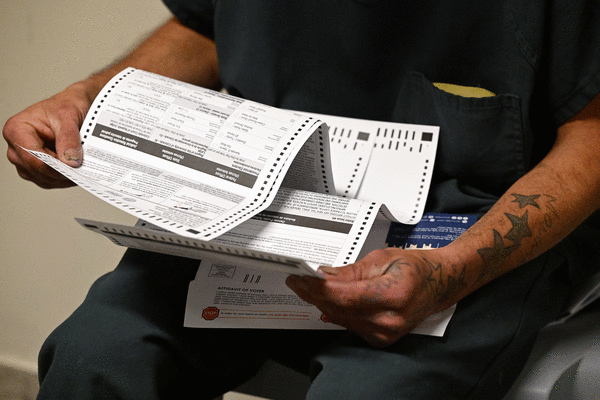
DENVER — Supporters of Colorado’s Amendment 85 say it would simplify the state’s increasingly lengthy and complicated ballots by bringing future proposals’ readability down to an eighth-grade level.
“I think a lot of people right now are opening their ballot and seeing, ‘Oh man, this is a huge ballot, it’s really complicated,’ ” said Landon Mascareñaz, whose group, Courageous Colorado, is backing the proposal. “And we need to make it more simple.”
But critics say the proposal would have another, more opaque effect: They argue it would be used to try to block recent efforts to bring more financial transparency to the questions posed to voters — just as deep-pocketed outside groups increasingly turn to the ballot to pass sweeping, complex policies.
“What this policy attempts to do is pull the wool over our eyes under the guise of readability, so (the amendment’s backers) can pull the wool over our eyes about the future impacts of ballot measures,” said Aly Belknap, the executive director of Colorado Common Cause, a government watchdog group.
The proposed amendment would require that future ballot questions be written at a level that an eighth-grader could understand. It also says no state law could interfere with that standard by requiring specific language in a ballot question.
It would undoubtedly change how questions are written. One of the most contentious measures on the ballot this year, Amendment 87, which would move Colorado to a graduated income tax, runs nearly 200 words unspooled in one single sentence.
But far from being focused on simplifying the ballot, critics argue that Amendment 85 is designed to hamstring — if not outright ban — recent transparency measures intended to give voters a better idea of what they’re voting on. That includes a 2022 state law that requires income tax-cutting ballot measures to include charts showing who would benefit from the tax reduction.
Part of critics’ suspicions are driven by the group that proposed Amendment 85: Advance Colorado, a conservative dark-money organization started by Republican megadonor Phil Anschutz and former Gov. Bill Owens. The group has repeatedly used the ballot box to pursue conservative policies, prompting criticism from Democratic lawmakers and backers of ballot-reform efforts.
Indeed, just this year, lawmakers passed a law requiring that any ballot measure that proposes a tax cut must identify state programs that will likely be reduced as a result of the cut. The law was adopted in direct response to Advance Colorado’s ballot campaigns, and critics of Amendment 85 say the new law would also be impacted if 85 passes.
Advance Colorado’s president, Michael Fields, denied that Amendment 85 was some sort of a Trojan horse. He said it was focused solely on readability and that it echoed concerns raised by voters about the complexity of Colorado’s ballot.
He said the amendment would not inherently undo existing transparency measures; it would only require that they be presented at an eighth-grade reading level.
"I don't think that a chart is beyond eighth-grade level," Fields said. "I guess I don't know where that (criticism) necessarily comes from."
Bedfellows
While Advance Colorado's deep pockets proposed Amendment 85, it made it on the ballot with the help of a wealthy Coloradan: Kent Thiry, the former CEO of DaVita.
He has his own extensive history with the ballot box — pushing a 2024 proposal rejected by the state's voters that would've opened up primaries to all voters and adopted a ranked-choice system for the general election — and with the legislature. Thiry is a funder of Mascareñaz's Courageous Colorado, which agreed in late summer to take on the 85 campaign, alongside a concurrent effort to defeat Amendment 84. That proposal would institute strict voter ID requirements for Colorado mail ballots by requiring voters to include a partial identification number when signing the envelope.
The pro-85 campaign involves paid influencers as well as support from groups that have financial or personal ties to Thiry or Courageous Colorado.
Advance Colorado is also part of Courageous Colorado's coalition, and it received financial support for an election reform educational campaign from another Thiry-funded group in 2024.
Mascareñaz said Courageous Colorado was not being paid by Advance Colorado. He would not say who was funding the pro-85 campaign, though Thiry said another group he supports — the Colorado Civic Alliance — would back it.
Mascareñaz noted that New York has an eighth-grade reading standard for its state ballots. Courageous is preparing for its own election-overhaul ballot campaigns in the years to come and has been doing research on voter concerns. Mascareñaz said readability is a top issue.
In an email to The Denver Post, Thiry said he backed Amendment 85 after the legislature did not include an eighth-grade reading requirement in a ballot reform bill passed earlier this year. Amid the same transparency concerns that critics now raise about Amendment 85, civic groups decided not to propose the 8th-grade standard, and state lawmakers instead passed a broader law, House Bill 1320, that says ballot questions must be written in plain language.
In February, a close aide to Thiry, as well as a senior Courageous official, were involved in early discussions about including the eighth-grade standard in HB-1320 — just as Advance Colorado was proposing Amendment 85 to the administrative body that sets ballot measures, according to emails reviewed by The Post. Fields said Thiry was not involved in 85's conception. Mascareñaz also said Courageous was not involved.
Thiry said he helped place 85 on the ballot, after it had cleared its earlier administrative hurdles. He did not reply to a Sunday email asking if he had been involved earlier, or if his and Advance Colorado's shared and simultaneous interest in an eighth-grade reading standard was coincidental.
"The right to vote should include the right to understand your ballot," Thiry told The Post last week.
He called the criticisms of Amendment 85 "a smokescreen."
Reading ease vs. transparency
But opponents argued that Amendment 85's professed commitment to simplified ballot language was the true distraction.
State Sen. Mike Weissman, who has backed some of the ballot transparency bills, said the measure's true intent was to form the basis for lawsuits undercutting those same reforms. Belknap said she had warned that an eighth-grade reading requirement would block transparency efforts during discussions about HB-1320 earlier this year.
The Colorado Latino Leadership, Advocacy and Research Organization, or CLLARO, backed HB-1320 earlier this year. Its president and CEO, Michael Cortés, said his group agreed to the broader approach that Belknap had proposed — using "plain language" that was accessible to the "widest possible audience" — because of concerns about implementation and transparency.
"The thing that has me concerned about 85 is that it repeals a number of other provisions that aren't readily apparent to voters," he said. CLLARO is also a member of Courageous Colorado's coalition, and he said he raised the concerns to the group. CLLARO is not taking a position on the ballot measure. "For all I know, that might be (its backers') ultimate objective."
Chris Beall, an attorney who has worked for the Colorado Secretary of State's Office, said the amendment would offer "full employment to lawyers" because of how much legal jousting it would prompt. He said the ballot measure was intended to undercut existing transparency rules and that oversimplifying ballot questions would only make them harder to interpret.
"One of the reasons we want ballot measures to be specific is so that we can avoid fights after the fact about what the ballot measure is intended to do," he said. (Beall's firm often represents Democratic causes and groups but is not involved in the Amendment 85 campaign.)
Mascareñaz, whose group plans to run its own ballot measures that would resurrect Thiry's 2024 push, acknowledged that the legislature and lawyers may have to determine Amendment 85's effects, should it pass.
But he and Thiry both argued that the ballot measure would only require adjustments to language; the legislature could still add any transparency requirements it wanted, so long as they were presented at an eighth-grade level.
"This will be an interesting thing to figure out in the next phase of the conversation, because some would argue it would make the ballot less transparent," Mascareñaz said. "I think that'd be a fair critique if we end up there. But I feel like that's three or four steps down the line. In the intervening period, millions more Coloradans (would) actually understand what's on the ballot. That's a pretty big net win."
Belknap said Common Cause left the coalition because of the disagreement over Amendment 85.
Mascareñaz said he respected Belknap and the group but disagreed with their interpretation.
"I don't want to lead into a space where we are having a more opaque anything," he said. "I think the eighth grade (reading level) allows us to get to a more simple thing."
_____
©2026 MediaNews Group, Inc. Visit at denverpost.com. Distributed by Tribune Content Agency, LLC.




Comments