Where are California's dead trees going? A forest advocate turned detective to find out
Published in News & Features
LOS ANGELES — A white SUV drives past fields of grapes and nut trees and pulls to a stop on the dirt shoulder across the highway from a strange tableau:
Thousands of burned tree trunks stacked neatly to the end of a country block, a mountain range of chipped wood piles rising behind them. Logs dangle like toothpicks from machines with hydraulic claws, and the whole scene is enveloped in dust.
The driver in the SUV waits. At 8:26 a.m., a red and white 18-wheeler loaded with chips pulls out of the yard near McFarland and turns south. When it's almost out of sight, she starts her engine and follows.
"I have to be careful," she says. Once, a driver spotted her and pulled over until she drove on. She assumed he thought he was being targeted by ICE.
Maya Khosla, a wildlife biologist for hire and filmmaker and poet between gigs, was getting on-the-job training in a new role: detective. Her mission: To find what happens to tens of thousands of dead trees being cut and trucked out of California's Sierra Nevada.
Khosla is part of a coalition of forest advocates who suspect the trees, which were killed in a wildfire, are being burned to generate electricity. The burning of "waste" wood and other organic material to produce energy is known as biomass energy.
Khosla and other environmentalists see the burning of dead trees as one environmental harm compounding another, arguing that biomass burns dirtier than coal and, contrary to the industry's claims, is not renewable because it takes a century or more for new trees to recapture the carbon.
And that is why, on a weekday in September, Khosla is tailing the truck on Highway 99, to see whether it's headed to a biomass plant.
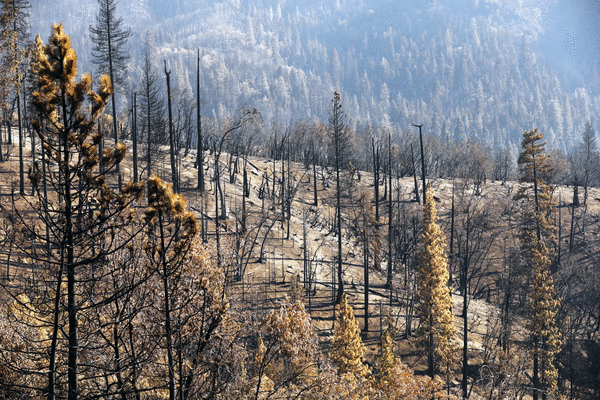
The chips were made from trees killed in the 2020 Castle fire, an inferno that left thousands of acres of standing dead trunks. Under a policy based on the premise that the dead trees, or "snags," will become fuel for future devastating wildfires and hinder planting of replacement trees, the U.S. Forest Service has contracted to have large swaths of them removed.
Khosla, who belongs to a group called Sequoia ForestKeeper, aligns with those who contend that the removal of snags robs the forest of trees at the most productive stage of their existence as a source of nutrients for a reborn forest and, until then, habitat for myriad species.
Her organization, along with two others, filed a federal lawsuit in September seeking to halt the logging in Sequoia National Forest on the grounds it is destroying habitat for three endangered species: the California spotted owl, the Southern Sierra Nevada fisher and the California condor.
"Snags are where everybody lives," Khosla says. "All the cavity nesters; all the nesters that rob the cavity nesters. Everyone is living in there. All of that is lost in one fell swoop. It's a sort of strip mining."
This year, the U.S. Forest Service asked for help disposing of dead trees culled from the forest. The biomass industry was very much ready to comply.
One of Khosla's colleagues had figured how the burned trees reached the yard near McFarland, about 22 miles north of Bakersfield. He had followed a truck from a dirt logging road somewhere high on the slopes of the Little Kern River canyon to the Western Divide Highway and down the twisty mountain road to the San Joaquin Valley.
in McFarland, he watched clawed vehicles lift each log and place it atop the stack of thousands that preceded it. All the while, another machine consisting of a motor, a cylindrical blade assembly and a conveyor belt swallowed logs into one end and delivered a stream of wood chips out the other.
In a trailer parked on the lot, he had found the operation manager. The manager was guarded but told him the chips were sold for high-end landscaping. Khosla and her colleague are skeptical.
"It's such a massive amount," she says. "It is unbelievable that it is landscape alone."
Now, as she follows the 18-wheeler, she feels she will soon learn what happens to the wood chips. The truck drives south, then west on Highway 46 through fields of almond trees and roses, before disappearing into an industrial zone near the farming center of Wasco.
"What the heck?" She loses sight of the truck and thinks it has pulled in behind a building bearing the name Pinnacle Prestress. What is it? She guesses that it makes particleboard, a common use of wood chips. (Actually, the company makes concrete structures. Most likely, the truck has gone elsewhere. But she doesn't know that in the moment.)
"Cool and not cool at all."
Cool because it wasn't biomass. Not cool because it left her thesis hanging.
Khosla, who has placed 24 motion-activated cameras in the Sierra Nevada to capture its elusive wildlife, is now pursuing an edgier project, a documentary film on biomass power. And it's not a glowing endorsement. She's done dozens of interviews chronicling an industry that rose to prominence in the 1970s and grew on subsidies designed to promote it as renewable energy.
Biomass fuel includes construction waste, orchard cuttings and nutshells, all things that would otherwise be burned in the field or sent to a landfill — thus the designation "carbon neutral."
At the industry's peak in the 1980s, 60 power biomass plants in California generated about 9% of the state's electrical energy. Since then, under mounting price competition from wind and solar, loss of subsidies and community opposition, the industry has contracted. Only about 20 plants remain in operation.
Among the relics of its decline is a hulking complex of rusted pipes, towers and conveyor belts in Delano, just five miles north of the McFarland chipping yard. After 25 years of operation, the Delano plant closed in 2015 under a barrage of community complaints over its emissions and fines from the San Joaquin Valley Air Pollution Control District.
For her documentary, Khosla aimed to follow a tree from high country to factory smokestack. After the false start at Pinnacle Prestress, she heads back to McFarland and awaits the next truck.
She follows it north on 99, then turns west at Pixley, till it stops at a field behind a large dairy and disgorges its load of wood chips. The scene was mystifying: A dozen or more low plastic platforms, each more than 20 feet wide, extend the length of the field with access space between them. Some of the platforms are covered in beds of wood chips. A front loader takes a scoop from the mound of wood chips and deposits it on a bare platform.
Something was being built. What is it?
"BioFiltro," a worker hailed by Khosla says. He didn't speak much English. All she got was something about worms and manure.
A phone search told a story she hadn't expected. BioFiltro, a company founded in Chile, puts red wigglers in a bed of chips to purify wastewater from dairy stalls. The filtered water is reused, and the chips break down with the worm castings into a soil amendment.
"So this is where the Sierra forest is going," Khosla says with astonishment.
The new knowledge challenged her value system. The tree fragments lying in BioFiltro's beds seemed to serve a beneficial purpose.
"That's not resulting in immediate emissions," she says. "So that's the good half of this."
The other half?
"I don't know what fraction it is," she says. "I know that they've got a bunch of clients and it's all about demand."
For that day, though, Khosla's sleuthing is done.
Several days later, in early October, she resumes her observation of the McFarland plant and begins following a truck headed south through Bakersfield.
She pulls alongside and sees a company logo that doesn't suggest biomass. Some trucks in the McFarland yard are loaded with the mineral gypsum, not wood chips, and Khosla doesn't know for sure what the truck is carrying. She breaks off the surveillance.
Back again in McFarland, she spots an 18-wheeler being loaded with chips. As it pulls away, it stops at the edge of the highway and the driver gets out to pull a cover over the cargo.
At this point in Khosla's sleuthing, the score was "O for three." She had found one use that challenged her thinking, a little: BioFiltro appeared to be carbon neutral and arguably had an ecological benefit — though not as great in her view as leaving the trees in place. She also had a close call with the sunk cost fallacy: the failure to disengage from a probably doomed pursuit because of the time already invested in it. On that score, she decides it's time for direct action.
She walks across the highway to ask the driver covering the cargo where he is going.
"Nevada," was all he would say. "Aha!" she thinks. There's a biomass facility near Reno that she believed was taking trees from Inyo National Forest.
But a long trip to Nevada was out of the question. With her cover blown anyway, Khosla crosses the powdery dirt yard to the trailer at the chipping yard. Inside, the manager declines to answer questions but gives her the company's website, Lignumsupport.com.
A web search yields a provocative clue. One of Lignum's clients was Mt. Poso Cogeneration Co., a biomass plant in the Sierra foothills. But its website said it is permanently closed.
To verify, Khosla drives 20 miles east to the Mt. Poso plant. It wasn't operating. But, unlike the rust bucket Delano has become, it wasn't abandoned either. A guard is on duty, cars are in the parking lot and lights on.
At this point in the journey, The Times, which had played along with the drama, abandoned its own sunk costs in favor of more traditional reporting. Lignum Support principal David Mittelstadt promptly returned a call. He spoke effusively of his 32 years in the fiber supply and the biomass energy sector, and his pride in its work.
"Everything that we produce is a beautiful sustainable product," he says.
The Nevada truck, he says, was delivering to a company that uses chips in a composite decking product.
Mittelstadt says his company once served biomass energy but not currently. The are no biomass plants left in the southern San Joaquin Valley, he says.
Khosla doesn't think that's the end of the story.
Indeed, in late September, Gov. Gavin Newsom signed an industry-friendly bill that has biomass opponents on edge. Assembly Bill 706 would set up an "incentive rate" for energy produced with forest biomass waste — dead trees — to "maintain and expand biomass power generation in the state."
Both the Delano and Mt. Poso plants are under new ownership and claim to practice a new "clean" version of biomass generation.
Mt. Poso's owner, Long Beach-based California Resources Corp., advertises itself as "a carbon management company that develops emissions reducing projects." It did not respond to an email from The Times.
After two days of sleuthing, Khosla's prey has eluded her. The evidence she gathered suggests it isn't there to be found — at least not yet.
But, in the spirit of the environmental mantra often attributed to writer Wallace Stegner, she'll be back. "Wilderness is always being saved," it goes, "but it is never quite safe."
©2026 Los Angeles Times. Visit at latimes.com. Distributed by Tribune Content Agency, LLC.






Comments