Q&A: John Bozzella, auto lobby group CEO, on relevance of USMCA, tariffs
Published in Automotive News
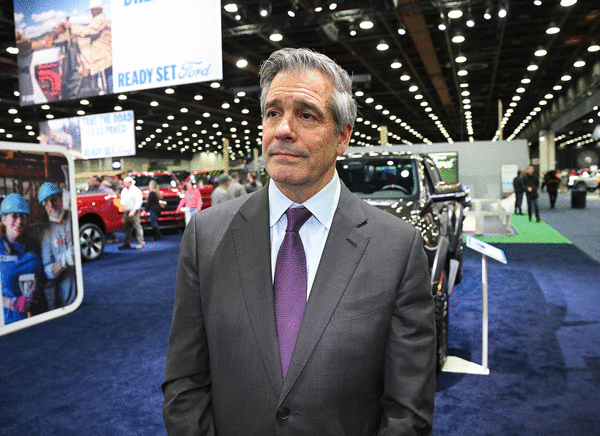
DETROIT — The CEO of the auto industry's largest lobbying group said President Donald Trump's remark last week that the trade deal he previously negotiated with Mexico and Canada was "irrelevant" is an unsurprising negotiating tactic in the early stages of trade deal renegotiation talks.
"We're in the early stage of this process," John Bozzella of the Alliance for Automotive Innovation said last week on the floor of the Detroit Auto Show, "so it's certainly understandable that parties to the agreement will make comments to set the terms of the negotiations. That's not terribly surprising to me."
The United States-Mexico-Canada agreement, however, he said, is very relevant for companies the trade group represents, which include major automakers except for EV maker Tesla Inc., and many suppliers. Automakers have said tariffs are costing them billions of dollars, they're seeking cost reductions to lessen the blow and some have announces major investments to move production to the United States.
Meanwhile, more than 20% of members of MEMA, the trade group for vehicle suppliers, indicate the list of suppliers for which they are watching concerning financial risks is more than 6% of their vendors, as tariffs, a pullback in electric vehicle plans and reshoring consume resources.
Bozzella spoke to The Detroit News on the economic impact of the U.S. auto industry, whether carbon emissions should be regulated and what he's learned from policy fluctuations over the past year.
Question: President Donald Trump this week in Detroit called USMCA "irrelevant" and indicated he is in no rush to renegotiate. Is that an accurate characterization, how important is that agreement for automakers, and what are your priorities in those conversations?
Answer: We're at the beginning of a process where the parties to the agreement — the United States, Mexico and Canada — get to assess the state of the agreement: how it's working for them and how it may not be working for them and what the rules should be going forward, whether they continue or change. We're in the early stage of this process, so it's certainly understandable that parties to the agreement will make comments to set the terms of the negotiations. That's not terribly surprising to me.
I think more importantly, for us here, as we stand at the Detroit Auto Show, is a recognition of the benefits that trade agreements between the U.S., Canada and Mexico are providing to American autoworkers and to American companies investing in the United States. We're providing customers with more affordable products. We're providing an opportunity to continue to build cars and trucks here in the United States for customers here but also for export around the world. So I think it's important to recognize the positive competitive aspect of USMCA. It's very, very helpful to the industry, and let's see how the negotiations go.
Q: In the wake of the Trump administration's imposition of more import tariffs on the automotive industry, automakers like General Motors Co. and Stellantis NV have announced billions of dollars in investments to move production from Canada and Mexico to the United States. Does that mean tariffs work for a more robust domestic auto industry?
A: There's a vibrant, competitive auto industry with 15 or more companies that are invested here in the United States, because it's a good place to do business, because we have competitive policies, good tax policy opportunities, good energy cost opportunities. To continue to invest and grow here in the United States, companies have to continue to assess the extent to which this is a competitive place to do business.
And there are a lot of things that go into it. Certainly, tariff levels are one of those things. Companies that are invested here want to be here. They want to be close to the customer. They're building here, because they want to be close to the customer. That's a good thing. But I think you have to look at the totality of policy to assess how the United States can continue to be a competitive place to build. But tariffs are certainly one of those elements in competitiveness, and they work both ways. They cut both ways.
Q: The Trump administration has sought to repeal the endangerment filing that allows the Environmental Protection Agency to regulate greenhouse gas tailpipe emissions regulations. Do you agree with the Trump administration that the emissions shouldn't be regulated or face penalties?
A: We have been pretty clear that the Biden-era emissions rules, given current market dynamics, were simply not achievable, and we think it is good that the agency reassess that and set a new set of rules going forward. That's really what we've focused on, is getting the balance right and making sure that we continue to support emissions reductions, and doing so in a way that's aligned with customer wants and needs now and in the future. So, that's been the total focus of our engagement with the regulators.
Q: 2025 had a number of changes on things like emissions regulations and tariffs — there was a lot when it comes to policy in Washington, D.C.
A: A lot!
Q: What were your learnings that you're taking into this year and whatever policy conversations come up?
A: There are a couple things. First of all, from an overall industry perspective, we have been grappling with an enormous amount of uncertainty, and so that's been a challenge to the industry. Uncertainty and lack of clarity with regard to what the rules are is a challenge for the industry, and I've never seen more uncertainty than that we're seeing over the past year. So, that was learning No. 1. We've got to get beyond the uncertainty. We've got to get back to durability, clarity, consistency and balance.
The second thing I've learned is that I learned resilience is really important. And I saw resilience in a number of places. I think the customer, the auto customer, is resilient. They're finding cars and trucks that they need and want, and they're buying them. I think the retailers, the dealer body, has been very resilient. So, resilience in this type of environment has been very important as well.
And then the last learning for me is: You've got to embrace change. Change is a constant. It's not an apparition. It's what we're dealing with.
©2026 www.detroitnews.com. Visit at detroitnews.com. Distributed by Tribune Content Agency, LLC.







Comments