To bring a prairie back to life, burn it
Published in Science & Technology News
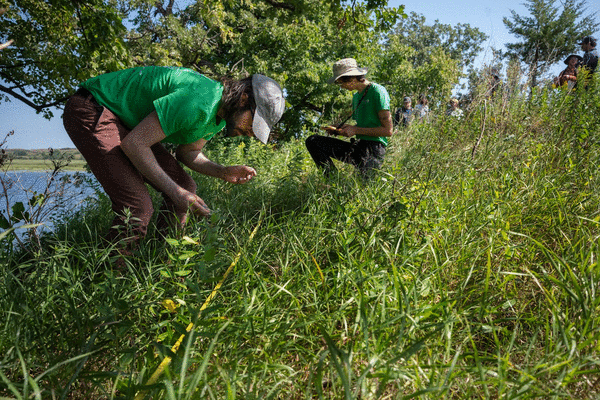
MINNEAPOLIS -- Twenty years later and the Kentucky bluegrass is still there. So are some of the invasive thistles, with their small thorns, as well as the tall thin reeds of the troublesome smooth brome.
But steadily, acre by acre, the native wildflowers and prairie grasses are returning to dominance in the Leif Mountain Preserve, an 850-acre span of an old homestead and pasture that was bought by the Nature Conservancy in the mid-2000s.
The nonprofit group has been working with state and federal agencies ever since to restore the prairie, to collect dizzying amounts of native seeds and to learn what tools and methods actually work to bring a sliver of grassland back to life.
The work here will help guide efforts to restore Minnesota’s dwindling native prairie. After two decades, one lesson is clear: Prairies need disturbance to thrive. At Leif Mountain, and dozens of other small pockets of prairie like it in the Upper Midwest, that starts with fire.
The problem with prairie restorations is that grasslands become quickly overrun by invasives. Native and beloved species, like red cedar trees, are also a constant threat to encroach and turn a Minnesota prairie into a Minnesota forest.
It’s never as simple as replanting native flowers and grasses and watching them thrive, said Angie Becker Kudelka, the deputy director of the Nature Conservancy in Minnesota, North Dakota and South Dakota.
“Grasslands need disturbance to be healthy,” she said. “And that disturbance is usually done in one of two ways: It’s either fire or it’s grazing.”
When it’s fire, it needs to be frequent.
For thousands of years prior to European settlement, grasslands evolved to rely on the periodic grazing from great herds of American buffalo. And they grew perhaps even more reliant on the frequent small fires set by lightning and by Native Americans, to keep red cedar from encroaching and to keep game coming back.
You can read the history of prairie fires in the burn scars on old oak trees and in the rings of their cores, said Hannah Boyer, a prairie recovery specialist for the Nature Conservancy.
“What you can see is there was this historic timeline of fires,” she said.
Old tree rings show evidence of small grass fires every three to five years up until about the 1910s, when fire bans were instituted across the region, she said. After that, the fires became much less frequent and much more intense.
The Conservancy has been trying to mimic that historic three- to five-year pattern at the Leif Mountain preserve, in the small city of Sunberg in Kandiyohi County. They divide up the 850-acres into a handful of sections and, like a crop rotation, burn one or two sections a year.
The benefits are almost immediate, said Megan Wilcots, an applied grassland climate scientist for the Conservancy.
“When we burn, we end up with more native grasses and fewer invasive species,” she said.
Native asters, goldenrods and other flowers seem to produce more seeds when they grow back following a burn. The layer of dead grasses, leaves and sticks built up on the ground over the years is consumed by the flames and turned into a nutrient-rich ash, exposing bare soil to sunlight and fertilizing the seeds that fall.
The grasses and flowers grow back so quickly following a burn that they are shoulder-high by August, almost indistinguishable in size from grasses on land that was not burned.
Fire may never be enough to completely eradicate certain invasive species like brome, Boyer said. But it keeps it in check enough that it doesn’t cause much harm to the diversity of native plants that do a better job feeding and sheltering insects, pollinators, birds and other animals.
Grazing takes longer to work, but over time, still helps natives establish a foothold in the prairie, the Conservancy has found.
The organization periodically invites neighboring farmers to bring their cattle to munch on the grasses at Leif Mountain, in an attempt to bring back some of the natural mowing that bison used to do.
In the first year or two after grazing, plant life doesn’t change much, according to the Conservancy’s records. But after about six or seven years of periodic grazing, there is a clear benefit.
“It shows how important long-term data is,” Becker Kudelka said.
Any kind of disturbance to the grasses is better than none, even if that means cutting them down like hay, Boyer said.
“That’s the most important part,” she said. “So if there is not availability for fire that year, can we graze it? If we can’t graze it, can we hay it? Can we do something, anything else to disturb shake it up and restart the nutrient cycling that they need?”
Leif Mountain Preserve is in a part of the state that has long been dominated by farmland but was never plowed or tilled itself. Part of what made it so valuable as conservation land is what made it only marginal as cropland — it’s full of steep hills and small ponds.
As crews surveyed the plants and collected thousands of aster and goldenrod seeds in a recently burned field on a windy day in August, all signs pointed to what Becker Kudelka had expected. The small prairie was healthy and getting healthier. Native species continued to gain ground and outpace invasives.
“I never get tired of that view,” Becker Kudelka said, standing near the center of the preserve.
On the horizon, tall grasses swayed in the wind on the treeless hills that encircle the preserve. Songbirds darted after insects. Hundreds of golden and purple flowers in bloom stretched toward the sun.
©2026 The Minnesota Star Tribune. Visit at startribune.com. Distributed by Tribune Content Agency, LLC.





Comments