Democrats' bill would nullify Trump's renaming of Lake Ontario
Published in Political News
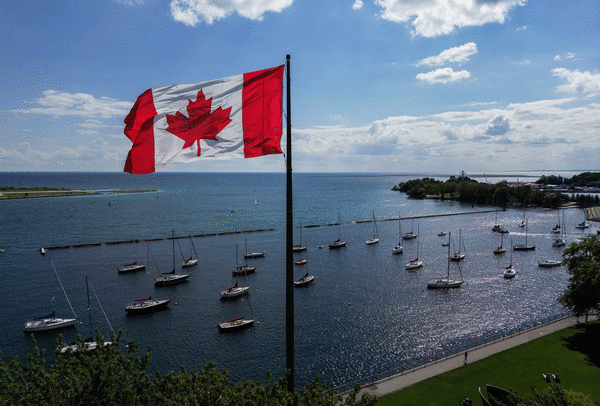
WASHINGTON — Michigan U.S. Rep. Debbie Dingell plans to introduce legislation next week that aims to undo President Donald Trump's executive order renaming Lake Ontario as Lake America, restoring the lake's indigenous name.
Dingell, a Democrat, told The Detroit News that she plans to introduce the "Hands Off Our Great Lakes Act" that would nullify the executive order issued by Trump on Aug. 27, rendering it without force or effect, according a copy of the bill. The Canada-bashing has to stop, she said, adding that it's endangering the economies and national security of both countries.
"There’s 400 years of history here. This lake was named before either country was created. This just has to stop," Dingell said.
"I was not happy because I’m very concerned about the long-term damage that’s been done to the relationship with a partner, ally and family member. Canada is not picking the war. Trump is."
Dingell is introducing the legislation with two Democratic colleagues, New York U.S. Reps. Tim Kennedy and Joe Morelle, that will also prohibit presidents from renaming any Great Lakes going forward, she said. Kennedy and Morelle represent districts bordering Great Lakes ― Kennedy's Lake Erie and Morelle's Lake Ontario.
Trump's move to rename the lake was viewed as a deliberate snub to Canada amid an escalating trade war with the United States' northern neighbor and second-largest trading partner.
"Canada has been ripping us off for a long time on trade, very sadly. Even the military. We defend Canada for nothing. We don't get anything. They don't pay us to defend Canada," Trump said Thursday in the Oval Office.
"They want to be treated like they're a state, and so we just can't do that anymore. ... The Canadian officials have treated us very badly. They're nasty people."
The lake renaming came after Trump's new 50% tariffs took effect on about 5% of imports from Canada after trade talks collapsed last week, with Canada over the weekend retaliating with "dollar for dollar" tariffs ranging from 15% to 50% on $20 billion worth of U.S. imports.
In response to Trump's action, Canadian Prime Minister Mark Carney noted the lake has indigenous origins that are more than 400 years old, predating the Confederation of Canada and the Declaration of Independence of the United States.
"We know that America is changing. Their trading relationships, their foreign policies, their national monuments, their hydronyms," Carney said. "Canadians also know that naming reality means calling it Lake Ontario ― then, now and always."
Lake Ontario is the only one of the five Great Lakes that doesn't border Michigan, running along western New York State on the U.S. side and serving as an important shipping route to the Atlantic Ocean
Trump's order states that U.S. federal government references to Lake Ontario, including on executive department and agency maps, contracts, and other documents and communications, must also reflect the renaming. Other countries don't have to recognize the change.
Dingell grew up on the St. Clair River in Michigan, overlooking Canada. Canada was as close to her home as Cannon House Office Building is to the U.S. Capitol, she said, referring to where her office is located on Capitol Hill.
"When you’re floating down the river in the inner tube, water doesn’t know what country it’s in. I mean, we share geography in ways that most other places don’t," Dingell said. "And we have responsibility between the two of us for more than 20% of freshwater in the world."
The name “Ontario” is an Anglican pronunciation of an Iroquois word that means something like “shining sea” or “beautiful lake,” said Daniel Macfarlane, a professor at Western Michigan University’s School of Environment, Geography and Sustainability and author of “The Lives of Lake Ontario.”
The lake's name predates European settlers or the founding of the United States and Canada. French settlers tried to rename the lake to Lac de St. Louis or Lac Frontenac, but those monikers didn’t stick, Macfarlane said. Ontario won out.
“Calling it Lake America is kind of ridiculous,” he said. “It’s far more a Canadian lake and far more important to Canada than it is to the U.S.”
A quarter of Canadians live within the Lake Ontario watershed, whereas the U.S. share of the Lake Ontario watershed is “backwoods” without a major city, Macfarlane said. The lake is integral to the Toronto economy, a major Canadian population center on the lakeshore.
Macfarlane questioned whether Trump can rename Lake Ontario as part of his campaign to pressure the Canadians back to the negotiating table on trade.
"Canada's not going to recognize it," Macfarlane said. "They have no way to compel Canada to recognize it. The rest of the world's not going to recognize it. It's just like the Gulf of America."
Last year, Trump issued an order to rename the Gulf of Mexico the Gulf of America on the first day of his second term.
(Staff Writer Carol Thompson contributed.)
©2026 The Detroit News. Visit detroitnews.com. Distributed by Tribune Content Agency, LLC.








































Comments