Republicans see Trump's unceasing Iran war as midterm threat
Published in Political News
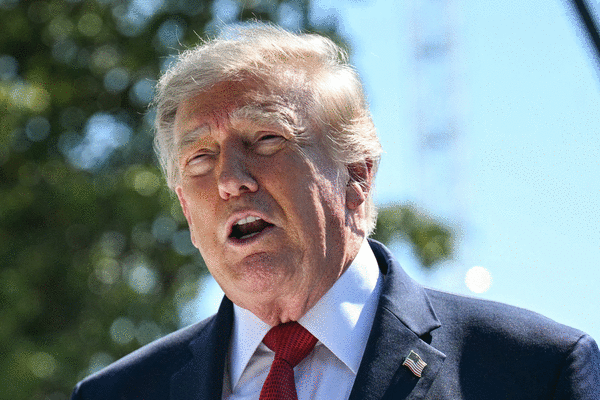
Six months into a conflict that President Donald Trump predicted would last “four to five weeks,” Republican strategists worry there’s no way to keep the Iran war from hurting the party’s prospects in November’s midterm elections.
The continuing hostilities have demoralized GOP voters, who sent Trump to the White House in order to tame inflation and keep the U.S. out of overseas conflicts.
Compounding Republican fears is the president’s apparent lack of concern, even as the unpopular conflict drags down his approval rating and polls showing rising voter frustration with the war and the high gas prices and stubborn inflation it’s fueled.
Some forecasters now say Republicans risk losing control of both houses of Congress if the president can’t reverse that sentiment before Election Day. That would threaten Trump’s agenda for the rest of his term and subject his administration to a raft of investigations by rival Democratic lawmakers.
From the outset, Americans were skeptical about the war, although the issue split largely along party lines. After the massive early bombing campaign did not produce an Iranian surrender and the disruptions to energy markets spiked gas prices and stoked inflation, public sentiment began to shift. In recent months, surveys show U.S. voters have steadily soured on the president, the war, and, increasingly, Republican candidates.
Many Republicans worry about the implications for November, but won’t say so publicly for fear of angering Trump. Several outside advisers to the White House, granted anonymity to speak candidly, said they do not expect the war to be resolved or gas prices to go down before November. They also worry that the White House has damaged its credibility on Iran after Trump’s repeated claims that the Strait of Hormuz is open to ship traffic and that gas prices are falling.
Trump has done little to assuage these concerns. On Monday, he took to social media to assert that his declining poll numbers are “fake” and that the U.S. is “winning” the war with Iran.
One adviser who met with Trump in the White House recently said the president expressed his long-held conviction that strength always beats weakness. The adviser, who didn’t contradict him, took this to mean that a change in Middle East strategy is unlikely to be forthcoming.
Political analysts said the president’s truculence over the war has become a major impediment for Republicans’ chances of holding onto power in Congress.
“It’s a pernicious issue for Republicans because it cuts directly against Trump’s strengths — he was the guy that was going to bring down prices and keep us out of endless wars in the Middle East,” said Amy Walter, editor of the nonpartisan Cook Political Report. “For many people who voted for him, there’s a sense of bewilderment and disappointment.”
On Aug. 20, the Cook Report shifted its rating of the Texas and Iowa Senate races — both traditionally red states that could affect which party controls the chamber next year — to “Toss Up.”
“No two elections are exactly alike,” she said, “but this year feels similar to 2006, when headwinds Republicans faced over the increasingly unpopular war in Iraq led to significant midterm losses.”
White House officials say they are confident the administration’s pressure campaign against Iran is working and that voters will credit Trump for what they see as a foreign policy success. On Thursday, he posted “Mission Accomplished 2026” with an image of the war.
“What matters most to the American people is having a Commander-in-Chief who takes decisive action to eliminate threats and keep them safe, which is exactly what President Trump is doing,” White House spokesperson Davis Ingle said. “The President does not make these incredibly important national security decisions based on fluid opinion polls or political pundits, but on the best interests of the American people.”
Polls show the growing frustration many voters have with the war and Trump’s inability to bring it to an end.
A recent Ipsos-Reuters survey found that 63% of Americans disapprove of the president’s handling of the Iran war, versus just 25% who approve. Four out of five surveyed said they anticipate U.S. military involvement continuing for an extended period.
The darkening outlook over the war is weighing on Trump’s popularity, with his approval rating mired at 33%, the lowest of his second term. Republican discontent over Iran is contributing to this slide: support for the war fell to 69% from 77% in March.
“Americans have never supported this war, and there’s no reason to think public opinion is going to change,” says longtime GOP pollster Whit Ayres.
GOP strategists are increasingly worried that negative sentiment could dissuade supporters from turning out to vote in November.
“The GOP base has not yet shown up for the midterm,” says Alex Conant, a veteran Republican strategist. “Democratic enthusiasm is through the roof, but Republicans haven’t come home yet.”
Conant says there’s still time for the party to execute a turnaround, especially if Trump can use the upcoming Republican midterm convention in Dallas on Sept. 9 to refocus the election on affordability.
But Democrats are seizing on the public discontent over the Iran War to attack their Republican opponents in TV ads and fundraising appeals. The war and its effect on fuel prices are a particular vulnerability for Republicans in the Midwest, according to party strategists.
“The war in Iran has made Ohio’s gas prices some of the highest in the nation and farmers are being crushed by the cost of diesel and fertilizer,” Democratic Senate candidate Sherrod Brown says in a new TV ad attacking the state’s Republican incumbent. “So why has Jon Husted voted 13 times for the war?”
Tavern Research, a Democratic political firm with multiple candidates running in midterm races, conducted a recent survey on the Iran war for its clients that it shared exclusively with Bloomberg News. The August 25th poll of 834 likely voters found that Democratic voters are nearly unanimous in their opposition to the war, with 96% disapproving of how Trump is managing the conflict and 65% saying it is “very important” to their voting decision.
But Tavern’s head of research and strategy, Jessica Reis, said anger over the war’s domestic economic costs among independents and many Republicans is what makes it such a potent political issue for Democratic candidates. In Tavern’s survey, 71% of voters believe the war has had a negative impact on the U.S. domestic situation, including 48% of Republicans.
“To voters, the war showcases Trump’s misplaced priorities,” said Reis. “It’s become a magnifying glass amplifying the issues people are most concerned about: rising prices and the cost of health care and housing.”
That could be especially costly for Republicans running in November. Tavern’s survey found many of the voters who say they’re undecided or unsure they’ll vote lean Republican. Most are unhappy about the conflict with Iran: 69% of undecided voters say they prefer to support a candidate who will end U.S. involvement in Iran, over 31% who support continued involvement.
The belief that the war is driving up costs is also reflected in public polling. In a recent CNN/SSRS poll, nearly three in four Americans said the war was not worth the financial burden and US casualties it has caused. Though a majority of Republicans still said they think the war was worth it, 43% say it wasn’t. What worries party strategists is that many of these frustrated voters supported Trump in 2024.
“For Trump, the war has challenged two of the main things he said he would accomplish: keeping the US out of new wars and lowering prices,” says Ayres, the GOP pollster.
Whether Trump can shift this impression over the nine weeks remaining until Election Day — and whether he’ll even feel inclined to try — could determine which party winds up controlling Congress next year. That, in turn, could shape the remainder of Trump’s time in office.
But there aren’t many Republicans left who are willing to question the president’s strategy on Iran.
That has left the public face of Republican opposition to the war in Iran to media figures like Tucker Carlson and a small group of elected officials who have been defeated and excommunicated from Trump’s circle, including Representative Thomas Massie of Kentucky and former Representative Marjorie Taylor Greene.
“Of all the stupid things this administration has done,” Massie wrote on social media recently, “starting a war in the Middle East will prove to be the biggest and most costly blunder.”
_____
With assistance from Gregory Korte.
_____
©2026 Bloomberg News. Visit at bloomberg.com. Distributed by Tribune Content Agency, LLC.














































Comments