Nvidia CEO Huang's close ties to Trump come under scrutiny after spy claim
Published in Political News
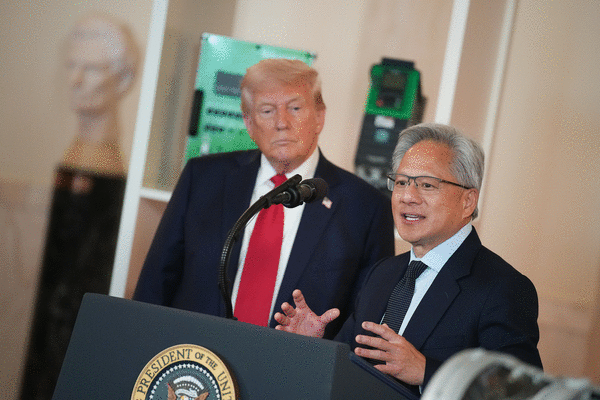
WASHINGTON — President Donald Trump wanted to know how Jensen Huang was holding up after admitting to an affair with a woman who may have been a Chinese spy. So on Monday, he spoke with the Nvidia Corp. chief executive officer — and came away satisfied with what he heard.
Recounting the conversation to reporters, the president said that Huang had assured him “he had absolutely no idea that the person in question was a spy.”
“I just know Jensen very well,” Trump said. “I just think he’s a very honorable man.”
The comments amounted to a full-throated defense of a tech titan who has spent the past two years forging a close alliance with the U.S. president. Few corporate leaders have enjoyed the kind of access to Trump as Huang, who emerged as one of the world’s most powerful technology executives as Nvidia’s artificial intelligence chips grew in importance to the global economy.
Huang has made frequent White House visits, received state dinner invitations and even hitched a ride on Air Force One to China. With that access, he gained massive clout with Trump’s White House on issues including the AI build out, export controls and U.S.-China policy.
Huang’s affair and Trump’s ties to the Nvidia chief are now raising fresh questions about how much the U.S. president knew about the matter, when he knew it, and whether any sensitive intelligence was exposed related to Washington’s AI arms race with Beijing.
On Tuesday, the New York Times reported that Secretary of State Marco Rubio reminded Trump of Huang’s relationship with the alleged spy when he brought the Nvidia chief to China on Air Force One for a state visit in May. The newspaper said it was at least the second time in seven months that Trump had been told of the matter.
That contradicted what Trump told reporters on Monday. Repeatedly pressed about when he had learned about the matter, Trump declined to offer details and denied he knew about it during the visit to China. “I didn’t hear about it then,” he said.
“What made Jensen Huang such a valuable intelligence target was his access to the president,” said Craig Singleton, senior China fellow at the Foundation for Defense of Democracies, a Washington think tank. “It could help Beijing inform its own decisions by learning what Washington was considering, and it could give Beijing a chance to influence U.S. decisions by shaping the advice that reached the president.”
The episode, which Trump said has triggered an FBI probe as well as separate calls for congressional investigations, has not appeared to shake the president’s confidence in Huang. Faced with repeated questions on Monday about their relationship, Trump returned over and over again to their personal friendship.
That, in turn, has underscored the dangers of Trump’s embrace of Silicon Valley leaders and his push for unfettered AI development. Huang’s affair also became public at a delicate moment, following a U.S. election in which voters expressed their disdain for the rapid proliferation of data centers, fueling a tech sector selloff on fading confidence in the durability of the AI boom.
Nvidia’s success has also provided a financial windfall for Trump, who last year held at least $12.5 million in Nvidia stock, according to financial disclosures. The White House has denied any conflict of interest and has said the president’s investments are managed by outside advisers.
Jensen Huang had previously denied any inappropriate relations with the woman, Alice Huang, an executive from Singapore-based Megaspeed International. The company became the largest buyer of Nvidia’s chips in Southeast Asia — a major route for smuggling the firm’s advanced hardware to China.
But after intense media attention, the Nvidia chief admitted an affair, putting his leadership of one of the world’s most valuable companies at risk. The company’s board said it launched an investigation into whether its leader was the target of a foreign intelligence effort, while insisting national security and “Nvidia secrets” had not been compromised.
“Frankly, this is a counterintelligence nightmare,” Ryan Fedasiuk of the Washington-based Foundation for American Innovation said Tuesday on Bloomberg Television. “I would be asking questions if I had a relationship with Mr. Huang about what kind of information might have inadvertently been passed to China.”
A Washington fixture
Since Trump’s return to office, Huang has become a fixture in Washington, endearing himself to the president as he sought to curb a ban on chip sales to China and expand his company’s political footprint. Last year, Huang attended a $1 million-a-head fundraiser at Trump’s Mar-a-Lago estate while Nvidia contributed another $1 million to the president’s inauguration fund.
Huang’s company also pledged $25 million toward the White House ballroom project, a major focus for the president in his second term, while also vowing to spend hundreds of billions to build out AI infrastructure, buoying Trump’s efforts to bring manufacturing back to the U.S.
Meanwhile, Nvidia has ranked as the world’s most valuable company for long stretches over the past two years, with a market capitalization topping $5 trillion as recently as last month. It has spent $4.7 million on federal lobbying so far this year, according to federal disclosures through the third quarter.
Huang has also been a frequent guest in the Oval Office and on Air Force One. He joined Trump for a trip to the Middle East in May 2025, where he announced Nvidia would sell chips to Saudi Arabia for AI data centers, appeared at major White House AI policy events and sat at the head table for a state dinner in honor of Chinese President Xi Jinping in September.
Yet more than a year before that dinner, in the summer of 2025, Nvidia’s general counsel intervened in an ongoing U.S. investigation of Megaspeed’s suspected smuggling of AI chips, Bloomberg previously reported.
Nvidia’s Tim Teter called Commerce Under Secretary Jeffrey Kessler to ask about the probe and whether the Bureau of Industry and Security was involved in the Singapore government’s detention of Alice Huang. BIS staff were later mandated to route all requests of Nvidia through Kessler or seek his approval for outreach.
Later in 2025, the Justice Department, which was working on the case with BIS — standard practice for any BIS investigation that turns into a criminal probe — requested that BIS pause its efforts, Bloomberg reported. BIS has not made any progress on the case since. Spokespeople for BIS and Nvidia denied any wrongdoing.
Trump has declined to say whether Huang will join him next week at the annual Asia-Pacific Economic Cooperation Leaders’ Meeting in Shenzhen, China.
But the questions percolating around the administration’s knowledge of Huang’s national security concerns have only increased calls for congressional probes.
Democrats, who have promised more oversight of the AI industry following their midterm elections sweep, are signaling plans to use the scandal to push for stronger chip export controls. Senate Democratic Leader Chuck Schumer accused the president of a “dereliction of duty,” seizing on news reports that he was told about the findings last year.
“The irony here is how much this has backfired on China,” Singleton said, noting that the episode may lead to stricter export controls on chips. “Even if Jensen’s policy positions were entirely his own, the suspicion of Chinese intelligence influence will make these arguments much harder to sell and accept.”
_____
With assistance from Riley Griffin, Skylar Woodhouse and Mackenzie Hawkins.
_____
©2026 Bloomberg L.P. Visit bloomberg.com. Distributed by Tribune Content Agency, LLC.





















Comments