Inside US sled hockey player Kayden Beasley's journey from NC to the Paralympics
Published in Olympics
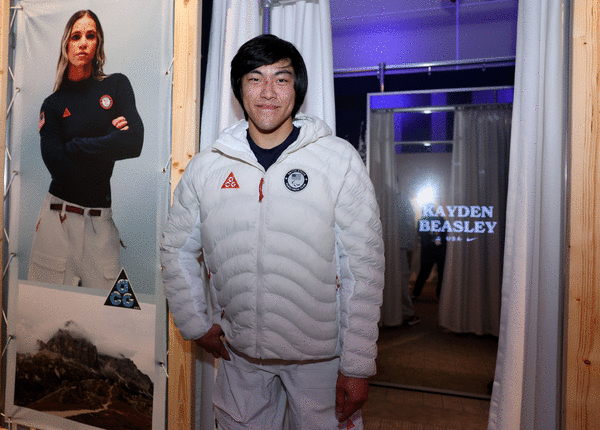
RALEIGH, N.C. — Six and a half years have passed since Kayden Beasley, then a 13-year-old adolescent with visions of hockey pucks dancing in his head, first attended practice with the Hurricanes Sled Hockey team at Polar Ice Raleigh.
This weekend, those dreams have carried him all the way to Italy, where Beasley, now 19, will represent the United States in the 2026 Milano Cortina Paralympic Games.
Beasley, from Coats, N.C., is a congenital double amputee above the knee, meaning he was born without the bottom portion of his legs. Sled hockey — known on the international stage as para hockey or sledge hockey — is an adaptive version of the sport, allowing individuals with disabilities and medical conditions to participate in a group sport.
Beasley traveled to Italy last week to begin his Paralympic journey. He is the only Team USA member from North Carolina, and one of the youngest. Despite his age, Beasley already has international experience. He joined the national team in 2024, participating in the International Para Hockey Games in Czechia and helped the team win gold.
“His first international tournament, I think the second game, he was named player of the game,” said Brian Jacoby, Hurricanes Sled Hockey co-founder and director. “He scores a ridiculous highlight reel goal against Team Italy.”
It was exactly five years since he’d joined the local club.
Beasley, young in his athletic career, now has another chance to represent the U.S. on an international stage. He is one of 14 athletes selected for Team USA, which seeks to earn a fifth consecutive gold medal in the event and add another hockey medal to the women’s and men’s hockey golds in the Olympics.
“It’s really cool,” Beasley said during a press conference at Lenovo Center in February. “This is the first Paralympics I’ve been to, so I’m excited.”
‘He’s a natural’
Jacoby remembered the first Saturday when Beasley showed up to the rink. Beasley had never played any adaptive sports, and had only ever played flag football and soccer with his church.
A physician’s assistant recommended the Hurricanes Sled Hockey club to Beasley and his family during a medical appointment in 2019. It would be a way for him to remain active and participate in a team sport like other children his age.
After Jacoby helped fit him with a sled and equipment, Beasley took to the ice for the first time.
“It just happened,” Jacoby said. “He’s a natural, and he’s never looked back. It’s easy to say now we knew immediately [he would be successful], but there was a very strong suspicion early on.”
Jacoby said it’s “life changing” to see individuals like Beasley get on the ice for the first time and discover their capabilities.
Shortly after Beasley began playing with the club — backed by the Carolina Hurricanes of the NHL — Jacoby and the other coaches encouraged him to apply for a USA Hockey camp. He was one of the top 60 players selected to participate.
The young athlete impressed the organization and asked to attend future camps. It wasn’t until he was on his second or third trip, with the backing of the Hurricanes Sled Hockey organization, that Beasley realized he could be successful in the sport.
“They were a big part in starting my journey,” Beasley said of the club. “I’m very grateful to have them. They taught the beginning stages and just supported me throughout all of it.”
‘Part of the journey’
Beasley’s full story began thousands of miles away from Raleigh — he was born in China in 2006 — and could easily have had a much different outcome.
In 1979, China introduced its one child policy in an attempt at curbing its booming population. The initiative, which immediately was subject to global criticism, restricted many families to one child.
The country established exceptions during its implementation, but it still had wide socioeconomic, cultural and demographic effects. Notably, the policy prompted an increase in orphanages after families were allowed to surrender their children to avoid penalties. The government, however, closed a loophole that allowed families to readopt their children. This led to the abandonment of infant girls — the culture valued sons over daughters — and children considered to have special needs.
The country repealed the policy in 2016, but Beasley, who was born 10 years prior, was abandoned by his biological family.
His parents, Anthony and Amy Beasley, adopted him at age 3, returning to North Carolina on Christmas Day 2009. He grew up in Coats, roughly 30 miles from Raleigh, and considers the small Harnett County town home.
“I was adopted from China and moved to America,” Beasley said. “I guess it’s all I’ve ever known.”
The Beasleys had also adopted Kayden’s older brother, Caleb, from the same Chinese province three years prior. Caleb is 20 months older than Kayden, and the two play sled hockey together, the eldest Beasley son joining the team after seeing his younger brother’s success and joy.
Beasley understands the importance of history, and always acknowledges where he came from, even ensuring that it’s listed on his Team USA biography page. But it’s what has come afterward that has made the greatest impact on where he is today.
Beasley’s family is his greatest support and inspiration. His parents have driven him to practices and events, even when it’s early in the morning, and traveled across the country to watch him compete. He’s not wearing a Team USA jersey without his family’s encouragement and sacrifices.
“[My adoption] is a part of the journey,” Beasley said, “but not all of it.”
Breaking down barriers
Hurricanes Sled Hockey was founded by Tyler Jacoby, son of Brian Jacoby and his wife, Kelly, in 2006. Tyler Jacoby was born with spina bifida, a condition that caused paralysis in his legs. He was inspired by the Carolina Hurricanes’ 2006 Stanley Cup Championship, and he wanted to play the sport, too.
The Jacoby family thought it might be a fleeting desire, but Tyler Jacoby was on the ice less than a year later.
Tyler is believed to be the first sled hockey player from the Carolinas, and his passion for hockey served as the catalyst for the club’s creation. It has steadily grown over the past 20 years, not only providing an outlet, but with the help of the Carolina Hurricanes Foundation, providing participants and their families with financial assistance. It serves children and adults, including active-duty and veteran military members, with disabilities or other health challenges.
“Our No. 1 purpose, why we exist, is to facilitate those kinds of things, to open doors for adaptive athletes,” Brian Jacoby said. “That’s why we’re here. It was a very expensive thing, and his parents couldn’t necessarily make that happen on their own, so the program steps in and fills the gap.”
The Hurricanes — the NHL franchise and the club — are excited for Beasley’s journey to the Paralympics, said Shane Willis, Hurricanes Director of Youth Hockey & Community Outreach. They’re equally excited about the positive impact Beasley could have on other young athletes.
“We’re excited to watch more kids walk into the rink on a Saturday and say, ‘I want to try and play hockey,’” Willis said. “I think there’s a number of parents and kids at home, they’re looking for a sport. And I think a lot of times, when you look at hockey, people think, ‘Well, it’s dangerous.’ We’re here to tell you that it’s not.
“We’re going to take down every single barrier that’s there for you and your family to get involved in what we feel is the greatest sport in the world.”
©2026 Raleigh News & Observer. Visit newsobserver.com. Distributed by Tribune Content Agency, LLC.



Comments