Bezos dismisses AI job-loss fears, predicts shorter workweeks
Published in Business News
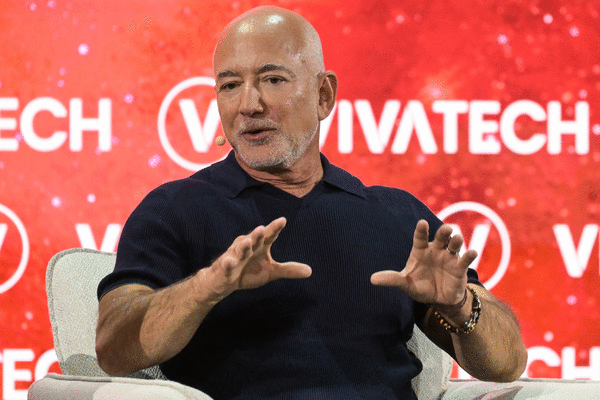
Amazon founder Jeff Bezos is predicting artificial intelligence will lead to soaring productivity, allowing people to back away from the workforce with no loss in their standard of living.
Bezos’ comments, made during an interview last week with Fox News, come as others warn that AI could decimate employment across swaths of the economy. In contrast, he said he believes there will be a labor shortage as people deprioritize work.
“It’s going to actually be difficult to hire people,” Bezos said during the interview, which took place on a factory floor in Florida for his spaceflight company, Blue Origin.
Bezos acknowledged that smart people are prognosticating" about widespread worker displacement — but he doesn't buy it. "I just happen to disagree with those smart people," he said.
Instead, Bezos said, rising productivity will let more people choose to work less.
“If you have, let’s say, a two-earner-income household,” he said, “if you want to have it, fine, you’ll have it. But if you don’t want to have it, one of the people might drop out. Some people will also decide, ‘You know what, I can support my family working three days a week.’ ”
As for the roughly 30,000 Amazon layoffs this year and last year, Bezos said the company’s head count had swelled during the COVID-19 pandemic.
Among those who do not share Bezos’ optimism about AI is Nobel laureate economist Daron Acemoglu, a leading voice on AI and work.
Writing in Microsoft's The Humanist Review of AI, Acemoglu estimates that about 5% of human tasks will be replaced by AI over the next decade, projecting an outcome closer to the economic status quo — rather than surging prosperity, or widespread job losses.
Bezos believes the dramatic boost in global wealth will stem from new AI tools accelerating the pace of human invention. His ambitious manufacturing venture, Prometheus — co-founded in 2025 with former Google executive Vik Bajaj — aims to build an "artificial general engineer" to shrink the gap between human ideas and physical manufacturing.
Bezos also argued in the Fox News interview that, at this stage, AI technology requires a "light hand" from federal regulators.
This comes as some in Congress push for mandatory transparency standards and third-party evaluations for artificial intelligence.
Government oversight works well for mature applications like aviation or prescription drugs, Bezos said, but base AI models are new, so there's still a risk of stifling innovation.
"You don't want to regulate knives, you want to regulate murder," he said. "Think of AI as a tool. That's all it is."
AI safety advocates see it differently, especially after AI agents OpenAI was testing gained unauthorized access to the internet and breached the servers of AI platform Hugging Face. The technology has the capacity to act autonomously and get out of control, these advocates say, arguing it’s time for the government to step in.
Bezos also offered his solution to the hotly debated issue of data centers, amid worries that the facilities pose environmental risks, strain local power grids and could raise nearby residents' energy bills.
His workaround is Project Sunrise, a Blue Origin initiative aiming to launch around 50,000 satellites that will allow for "orbital data centers” in space. The plan has drawn criticism from NASA, which is concerned by the lack of detail to show how the satellites wouldn’t endanger the International Space Station or interfere with science missions.
Asked about how U.S. Sen. Bernie Sanders, a Vermont independent and a proponent of data center moratoriums, talks about billionaires, Bezos rejected what he described as an “oppressor-oppressed framework” that he said some people have "been taught."
"Success is not villainy,” he said.
©2026 The Seattle Times. Visit seattletimes.com. Distributed by Tribune Content Agency, LLC.





Comments